
English


Views: 0 Author: Site Editor Publish Time: 2026-10-17 Origin: Site


Scaling pastry production using off-the-shelf pans carries severe financial risks. Standard baking sheets distribute heat inconsistently across large commercial ovens. This thermal inconsistency routinely leads to ruined lamination, excessive butter pooling, and uneven crust browning. Transitioning to custom tooling requires a massive strategic shift. You must precisely align delicate pastry science alongside harsh manufacturing realities. Automated production lines demand specific rack dimensions, tight equipment tolerances, and highly predictable daily yields. This guide explores the exact criteria necessary to evaluate standard-defying commercial trays. We cover essential material choices, crucial airflow dynamics, and layout densities. You will learn how to protect delicate product quality while maximizing bakery output. Ultimately, proper hardware selection safeguards your profit margins and ensures long-term operational success.
Customizing a multi-mold tray requires balancing mold density with the thermodynamic needs of croissant lamination.
Material thickness and perforation patterns directly dictate bake consistency and prevent butter leakage.
Commercial coatings must be chosen based on the fat content of the dough and the facility's recoating budget.
Always require a single-tray prototype for small-batch testing before committing to a full production run.
Standard sheet pans fundamentally limit baking automation and product uniformity. When you scale up operations, manual panning becomes too slow and highly unpredictable. Bakeries need specialized equipment to lock in specific dough dimensions. Consistent dimensions guarantee strict packaging uniformity downstream.
Custom multi-mold baking trays solve this operational problem by significantly reducing manual handling. They drastically improve rack density inside commercial ovens. Properly designed molds physically guide the dough as it expands during baking. This mechanical guidance minimizes scrap rates caused by misshapen or fused pastries.
To evaluate your potential return on investment, consider these operational benefits:
Reduced labor costs during the demolding phase.
Fewer rejected products due to uniform shape control.
Higher throughput per baking rack.
However, you must constantly balance scalability against manufacturing flexibility. A custom pan locks your bakery into one precise product specification. Buyers must ensure they finalize their recipe and product size entirely before investing heavily in custom molds. Once manufactured, these heavy-duty trays cannot adapt to larger or smaller dough weights. Validate your product dimensions thoroughly before writing the tooling purchase order.
Customizing pastry trays requires precise engineering and dough chemistry knowledge. You must calculate the exact millimeter dimensions needed for your specific dough weight. You must define the ideal length, width, and depth carefully. Small spatial miscalculations routinely ruin the final product shape.
Next, bakery buyers face the classic density dilemma. Overcrowding the pan maximizes your hourly baking throughput. Yet, overcrowding physically traps moisture between adjacent pastries. This trapped steam leads to pale sidewalls and compromised, dense flakiness. Conversely, under-crowding wastes valuable oven real estate and severely reduces operational profitability.
Proper spacing accommodates the rapid volumetric expansion of croissants. During proofing and initial oven spring, laminated dough requires aggressive heat transfer. Adequate layout density prevents neighboring pieces from fusing together. Expert bakers know airflow must circulate freely around every single pastry.
Consider these dynamic lamination factors when spacing your molds:
Initial butter melt rates require rapid moisture evaporation.
Steam generation forces the dough layers upward and outward.
Crust formation relies on unobstructed ambient oven heat.
If the trays block this crucial airflow, delicate butter layers melt instead of generating lift. Give your dough enough physical room to achieve optimal lamination separation.
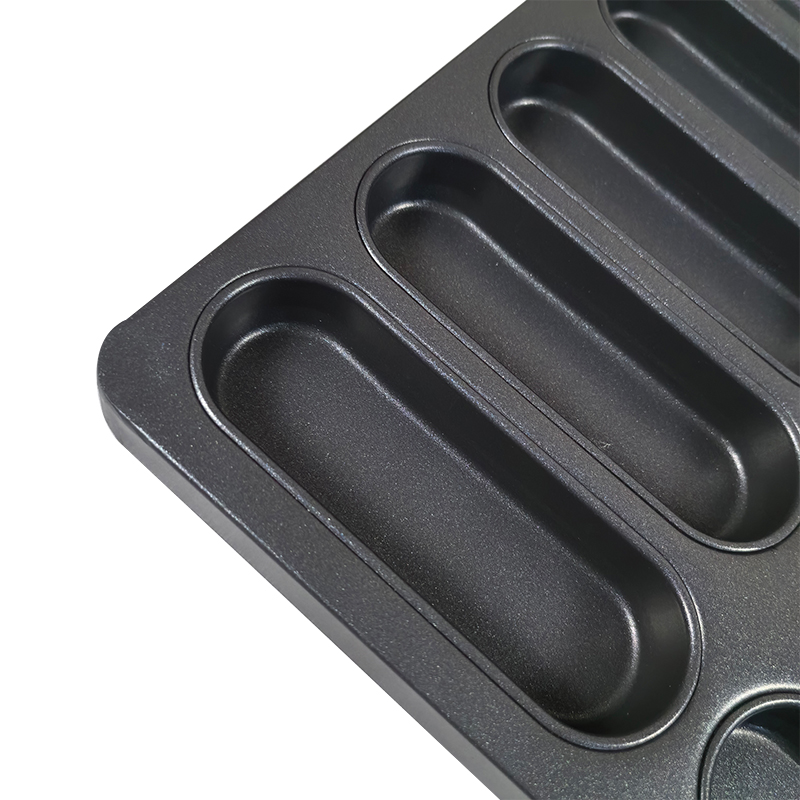
Choosing the right metal dictates how your oven transfers heat to the resting dough. Bakeries primarily choose between two specialized industrial metals.
Aluminized steel offers superior durability and incredible warp resistance. This heavy-duty material excels on heavy-volume automated production lines. It heats up much slower than raw aluminum. However, it holds its temperature exceptionally well during busy oven loading cycles.
Anodized aluminum delivers much faster heat transfer. This thermal speed proves ideal for achieving a rapid, explosive oven spring. However, aluminum remains far more susceptible to physical damage over time. Routine industrial handling easily dents softer aluminum frames.
You must avoid choosing overly thin metal gauges just to save upfront manufacturing costs. Thin pans warp violently under high commercial baking temperatures. This thermal warping permanently alters the mold shape. Bent trays cause uneven browning and misaligned automated demolding. You risk jamming your conveyor belts if warped trays enter the cooling spirals.
Table 1: Material Comparison for Laminated Dough Trays
Material Specification | Heat Conductivity Rate | Physical Durability | Ideal Bakery Use Case |
|---|---|---|---|
Aluminized Steel (16-18 Gauge) | Moderate and Retentive | Exceptionally High | Heavy automation lines, long lifespans |
Anodized Aluminum (14-16 Gauge) | Rapid and Direct | Moderate | Maximum oven spring, manual rack loading |
Airflow management literally makes or breaks a delicate laminated pastry. Pan manufacturers control this thermodynamic variable through custom mold perforation.
Solid molds offer excellent operational security. They contain melting butter perfectly if your daily lamination process isn't flawless. However, solid metal traps moisture underneath the expanding dough. You risk producing a denser, far less crispy bottom crust.
Perforated molds provide direct, aggressive airflow directly to the dough bottom. This unobstructed airflow greatly enhances the crispness of the lower pastry layers. It promotes an incredibly even, flaky overall texture. A high-end croissant baking pan often utilizes precision micro-perforations to achieve this artisan-style finish.
The implementation reality requires extreme operational caution. Perforations demand a highly dialed-in lamination process. If your dough leaks excess butter during baking, it will drip straight through the tiny holes. Dripping butter creates severe oven smoke. It also forces immediate, highly costly oven maintenance interventions. Match your pan design explicitly to your dough stability.
Never trust a tool manufacturer promising "lifetime" non-stick coatings. All commercial coatings degrade under industrial use and ultimately require routine resurfacing.
Silicone glaze offers a highly cost-effective release solution. It provides excellent release properties for high-sugar or high-fat items. Unfortunately, silicone glaze inherently has a shorter operational lifespan. High-volume commercial bakeries must recoat these specific trays frequently to prevent sticking.
PTFE and Teflon blends boast much longer functional lifespans. They remain highly durable across thousands of high-heat baking cycles. However, PTFE requires strict adherence to safe operating temperatures. Exceeding specific heat limits degrades the polymer surface and violates strict food safety compliance.
Coatings must match the specific dough chemistry perfectly. The fat content in a standard laminated pastry differs vastly from other baked goods. For example, a commercial hot dog bun pan handles much lower fat levels and higher moisture doughs. Conversely, a specialized donut baking pan manages entirely different batter densities and sticky sugar contents. You cannot swap coating specifications blindly across totally different product lines.
You need a rigorous evaluation framework to vet custom pan manufacturers properly. Look for trusted partners offering robust in-house engineering support. They should provide detailed 3D CAD drawing capabilities. Ensure they also outline clear, predictable recoating service programs.
Follow these steps when shortlisting potential tooling vendors:
Review their portfolio of successful laminated dough projects.
Assess their typical manufacturing lead times.
Evaluate their ongoing maintenance and recoating logistics.
Prototyping remains a strictly non-negotiable step in procurement. You must demand a physical prototype before authorizing expensive mass production. Run a small-batch test in your actual bakery ovens. Use this crucial trial to evaluate heat flow, demolding ease, and dimensional stability. Verify exactly how well the prototype fits onto your existing bakery racks or cooling conveyor belts.
Take specific next-step actions to protect your capital investment. Request a comprehensive spec sheet review from shortlisted vendors. Demand physical material samples to verify the actual metal gauge. Once you validate the Multi-mold Trays in a real-world bake, you can safely approve the final CAD design.
A successful custom pan investment bridges a notoriously difficult gap. It merges delicate pastry thermodynamic requirements securely against brutal industrial durability. Bakeries must harmonize these two competing forces to scale their output successfully.
Remember, a custom pan will never fix a fundamentally flawed recipe. In fact, scaling up will only magnify underlying lamination issues further. Validate your dough handling process thoroughly first, and then build the specialized pan around it.
Start by auditing your current scrap rates and physical oven dimensions. Document your exact raw dough weight and final proofed volume. Gather these internal metrics carefully before requesting engineering quotes for your next major tooling upgrade.
A: Typically, 16-gauge to 18-gauge aluminized steel or aluminum is recommended. This specific thickness prevents the metal from warping under continuous high-temperature commercial cycles. At the same time, it ensures adequate and rapid heat transfer to achieve the necessary oven spring for laminated doughs.
A: Depending on your daily usage volume and the exact coating type applied, recoating schedules vary. Commercial bakeries usually schedule resurfacing every 9 to 18 months. Silicone glazes typically wear out faster, while advanced PTFE blends might push the recoating boundary closer to the 18-month mark.
A: Yes, you can use the same molds provided the target dimensions and raw dough weights match the mold volume perfectly. However, varying fat contents in different recipes might affect the longevity of your non-stick coating. High-fat or high-sugar fillings can degrade certain coatings faster.


