
English


Views: 0 Author: Site Editor Publish Time: 2026-10-15 Origin: Site


The commercial shift toward baked donuts offers bakeries higher margins and significantly lower oil costs. Yet, scaling production introduces a critical operational bottleneck. Facilities must maintain consistent shape, texture, and bake times across thousands of units daily.
In high-volume environments, selecting the wrong cavity size inevitably leads to uneven browning, batter overflow, or inefficient rack oven space usage. A slight miscalculation in mold depth drastically alters heat penetration and compromises center baking. You simply cannot afford guesswork when outfitting an automated bakery line.
Selecting the correct cavity dimensions in Multi-mold Trays represents a strategic operational decision. This comprehensive guide breaks down how you should evaluate cavity sizes, assess tray materials, and optimize configuration layouts. By the end, you will understand how to maximize yield and ensure seamless automated depositor integration.
Yield vs. Quality: Cavity diameter and depth directly dictate batter volume, which alters thermal penetration and overall bake time.
Standardization: Standard 3-inch to 3.5-inch cavities offer the most predictable ROI for traditional cake donuts, while deeper cavities are required for cream-filled or specialty variations.
Equipment Compatibility: Tray dimensions must align not only with oven racks but with automated batter depositor nozzles to prevent waste.
Material Matters: High-volume production requires rigid, thermally conductive materials (like aluminized steel) over consumer-grade silicone to withstand commercial wash cycles and continuous use.
Baking donuts at scale requires precise mathematical alignment between pan dimensions and oven capacity. You must define success criteria early. Operations managers typically evaluate tray efficiency by calculating the product yield per square foot of oven space. They balance this metric against the energy cost per bake cycle. A tray holding 24 small cavities might seem more productive initially. However, dense pan configurations sometimes impede airflow. Poor airflow extends baking times. Therefore, you must find the optimal balance between high cavity density and efficient convection flow.
The thermal dynamics of batter displacement also dictate success. Cavity depth directly affects the center-bake of dense cake donut batters. We often see bakeries struggle with improper mold depths. Shallow cavities expose too much surface area. They risk drying out the crumb structure before the center sets. Conversely, overly deep cavities trap moisture. They risk gummy, underbaked centers. Heat must penetrate the batter evenly from all sides. The central cone of the mold plays a vital role here. It conducts heat directly into the core of the donut. You need a precisely engineered cone to guarantee a uniform bake.
Consistency at scale defines your brand reputation. Uniform cavity stamping in commercial pans remains non-negotiable. Stamped cavities ensure every single donut matches the exact same dimensions. This precision prevents product rejection at the end of the line. Consider your downstream packaging operations. Standardized boxes and clamshells require uniform product sizes. If a donut expands too widely due to a shallow cavity, it will not fit the packaging. Such packaging mismatches slow down automated wrappers and increase labor costs.
Yield calculation: Measure the total number of cavities per rack against the minutes required to bake them fully.
Crumb texture: Match cavity depth to your batter hydration level to prevent gummy centers.
Packaging fit: Standardize mold diameter to ensure seamless transition into automated packaging lines.
Bakery menus continually evolve, but pan dimensions generally fall into three distinct categories. Selecting the right donut baking pan means understanding the operational realities behind each size. You must align the pan specifications with your target market.
Mini or bite-sized cavities typically range from 1.5 inches to 2 inches in diameter. Bakeries use these primarily for catering events, wedding dessert tables, and high-margin snack packs. Consumers love bite-sized treats. However, operational realities present unique challenges here. Small cavities require highly precise depositor calibration. Even a slight over-deposit causes batter to spill over the center cone. Furthermore, mini donuts bake incredibly fast. Faster bake times mean a much narrower margin for error. You must monitor ovens closely to prevent burning.
Standard coffee-shop cavities range from 3 inches to 3.5 inches. This size serves as the industry baseline. You will use these molds for traditional glazed, old-fashioned, and vanilla cake donuts. This dimension offers the best balance of structural integrity and optimal crust-to-crumb ratio. The standard size forgives minor batter fluctuations. It holds glaze well and fits perfectly into standard bakery boxes.
Jumbo and deep-well cavities exceed 3.5 inches in diameter or feature extended depth. You need these specialized pans for cream-filled, injected, or heavily topped baked donuts. The operational reality shifts significantly for jumbo sizes. Thicker batters require lower baking temperatures for longer durations. A slow bake ensures structural stability. The donut walls must be strong enough to withstand post-bake filling injections without collapsing.
Table 1: Commercial Donut Cavity Dimensions and Applications
Cavity Category | Diameter Size | Primary Use Cases | Operational Challenge |
|---|---|---|---|
Mini / Bite-Sized | 1.5" - 2" | Catering, weddings, snack packs | Requires strict depositor calibration to avoid overfill. |
Standard | 3" - 3.5" | Traditional glazed, old-fashioned | Industry baseline; requires consistent heat distribution. |
Jumbo / Deep-Well | 3.5"+ or custom | Cream-filled, injected, heavily topped | Needs lower temperatures and longer bakes for stability. |
Choosing the correct metal substrate separates successful wholesale bakeries from struggling ones. You must evaluate thermal conductivity alongside physical durability. Aluminized steel and anodized aluminum dominate the commercial sector. Aluminized steel combines the structural strength of steel with the heat-reflective properties of aluminum. It provides the heavy-duty rigidity needed for automated conveyor lines. The metal will not warp under repeated thermal stress. Aluminum, on the other hand, offers rapid heat transfer. It heats up quickly and cools down fast. However, pure aluminum bends easily under rough commercial handling.
We must also evaluate commercial coatings. Release efficiency directly impacts your bottom line. Manufacturers typically apply silicone glazes or PTFE (Teflon) coatings. Silicone glaze offers an excellent natural release for low-sugar batters. However, high-volume facilities must factor in the recoating lifespan. A standard silicone glaze typically lasts between 300 and 800 bakes. High-sugar donut batters degrade silicone faster. PTFE coatings last much longer and withstand higher abrasion. They resist sticky, high-sugar glazes effectively. You should consult your pan supplier to match the coating chemistry to your specific batter ingredients.
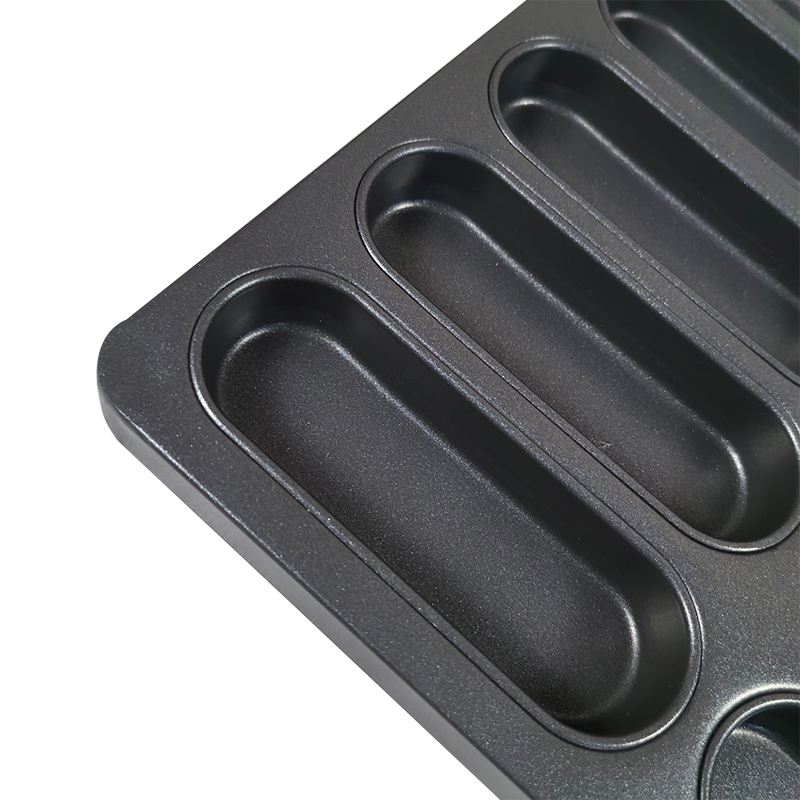
Cross-category tooling knowledge proves incredibly useful here. The thermal principles governing a commercial donut mold mirror the requirements of a commercial hot dog bun pan or a croissant baking pan. All these products demand exceptional airflow between molds. Solid, unperforated trays trap cold air pockets in convection ovens. Perforated trays or strapped pan configurations allow hot air to circulate freely. Proper air circulation guarantees even coloring on the bottom of the baked goods. When you optimize airflow, you reduce bake times and improve crust development.
Deploying new multi-mold baking trays introduces specific mechanical risks on the production floor. Depositor compatibility stands out as the most common hurdle. You risk mismatching the cavity diameter with the depositor nozzle spread. If the nozzle pushes batter wider than the mold opening, edge-spillover occurs. Spilled batter burns on the tray surface. It creates bitter flavors and ruins the aesthetic. Furthermore, an off-center deposit yields asymmetrical donuts. You must ensure the nozzle height and spread pattern perfectly align with the cavity draft angles.
De-panning speed heavily influences production efficiency. In high-volume settings, donuts must release cleanly via rack inversion or automated suction arms. Cavity walls feature a specific slope, known as the draft angle. Molds featuring overly steep walls increase the friction coefficient. High friction leads to product tearing during extraction. Torn donuts become waste. Proper draft angles allow gravity to assist the release process smoothly.
Wash cycle degradation represents a hidden operational danger. Aggressive commercial detergents destroy non-stick coatings quickly. Many bakeries use harsh caustic chemicals to remove burnt sugar. This practice strips the silicone or PTFE glaze right off the metal.
Select pH-neutral detergents designed specifically for coated bakeware.
Use soft-bristle automated washers instead of abrasive scrubbing pads.
Ensure trays are thoroughly dried immediately after washing to prevent substrate corrosion.
Select molds featuring wider draft angles. They make mechanical cleaning significantly faster.
Upgrading your pan inventory requires a systematic approach. Do not rely on guesswork or catalog pictures alone. Follow a structured shortlisting process to ensure seamless integration.
Step 1: Audit Oven and Rack Specs. Start by measuring your exact rack dimensions. Ensure the overall tray size maximizes your specific rack capacity. Standard commercial sheet sizes measure 18x26 inches. However, large industrial rack ovens often accommodate custom strapped pan configurations. You must optimize every inch of available shelf space.
Step 2: Calculate ROI on Yield. Compare different pan layouts before committing. Evaluate a 15-cavity layout versus a 24-cavity layout. Higher density seems better on paper. However, factor in the potential increase in bake time for denser tray configurations. Tightly packed cavities restrict convection airflow, sometimes reducing overall daily throughput.
Step 3: Request Sample Testing. Never roll out a full tray inventory blindly. Always request a sample tray from the manufacturer. Run it through your actual production line. Test it using your specific batter formulation. Observe how your depositor interacts with the molds. Check the oven airflow pattern. Monitor the release quality during de-panning.
Sample testing reveals hidden incompatibilities. It allows you to adjust batter hydration or oven fan speeds before you finalize a massive equipment order. Small adjustments during the testing phase save thousands of dollars in wasted product later.
Cavity size remains much more than a simple product design choice. It functions as a core operational metric impacting bake time, equipment compatibility, and overall profit margins. Understanding how batter volume interacts with mold depth allows you to engineer the perfect crumb structure consistently.
Start your optimization journey by strictly defining your core product catalog. Decide whether standard cake donuts, mini versions, or filled pastries drive your revenue. Match your desired cavity volume directly to your automated depositor capabilities to prevent batter waste. Finally, always invest in commercial-grade coated trays. High-quality aluminized steel minimizes de-panning labor and resists commercial wear.
Your next step requires engaging directly with a commercial bakeware manufacturer. Request detailed technical spec sheets and order a sample tray tailored to your production line. Conduct thorough testing to validate heat distribution and release efficiency.
A: Most commercial operations use a 3-inch to 3.25-inch diameter cavity. This dimension yields a standard 2.5 to 3-ounce finished baked donut. This specific size optimizes both convection bake time and the consumer's perception of portion value.
A: Yes, in many cases. Even with premium commercial non-stick coatings like silicone glaze, high-sugar donut batters tend to stick. You may require a light, automated release spray application to guarantee a 100% clean release during high-speed de-panning operations.
A: Yes, you can use the same trays. However, hydration levels and sugar content vary significantly between recipes. A dense old-fashioned batter behaves differently than a light vanilla cake batter. You must adjust your oven bake times and release agent volumes accordingly.
A: Avoid abrasive scrubbing pads and harsh caustic chemicals completely. Use only pH-neutral detergents. Run the pans through soft-bristle automated washers. Always ensure trays are thoroughly dried immediately after the wash cycle to prevent the underlying substrate from corroding.


