
English


Views: 0 Author: Site Editor Publish Time: 2026-10-13 Origin: Site


Commercial kitchen profitability relies heavily on the quality and durability of non-stick coatings. When you choose the right surface, you actively reduce product loss. You also minimize the grueling labor spent on scrubbing, all while guaranteeing a standardized bake quality.
High-volume bakeries often treat standard Baking Sheet Pans as cheap, disposable commodities. Kitchen managers frequently overlook how rapid wear damages their bottom line. This disposable mindset leads to compounding replacement expenses. It also causes highly inconsistent food release when cheap coatings inevitably degrade under intense commercial pressure.
Our goal is to provide a transparent, material-science-based evaluation framework. We want to help operational buyers cut through marketing noise. You will discover how to select the precise non-stick coating for specific commercial baking applications. By understanding critical material thresholds, you can make smarter procurement choices.
Not all non-stick surfaces scale; PTFE, silicone glaze, and ceramic coatings each have strict thermal and abrasion thresholds that dictate their commercial viability.
The structural design of commercial baking sheet pans (e.g., solid vs. perforated) alters how coatings adhere, wear, and release moisture.
Food safety compliance (FDA/SFA standards) requires ongoing monitoring of coating degradation, making predictable wear patterns a critical purchasing feature.
Total Cost of Ownership (TCO) should dictate procurement, factoring in wash-cycle limitations and release-agent savings over the pan's lifecycle.
Operational leaders must view pan procurement through a strategic lens. A common mistake is judging a pan strictly by its initial purchase price. Instead, you should measure its value against daily operational efficiencies.
Compare the upfront cost of premium-coated pans directly against daily labor hours saved. At the dishwashing station, heavily soiled uncoated pans require intense scrubbing. This burns valuable labor minutes. Premium coatings allow staff to swiftly sanitize equipment. The labor savings over six months often exceed the premium price tag.
Consistent food release also acts as a direct form of yield protection. Delicate baked goods often tear when they stick to degraded surfaces. Structural damage ruins the aesthetics of pastries and breads. Ruined aesthetics mean you cannot sell the item at full price. Reliable non-stick surfaces ensure your sellable yield remains exceptionally high.
Finally, managers must address the operational "burn-off" reality. Commercial heat cycles accelerate coating degradation rapidly. Marketing brochures often promise indestructible surfaces. This is a myth. The actual procurement goal is finding predictable, manageable wear patterns. You need to know exactly when a pan will fail. Predictability allows you to budget for replacements before poor performance impacts food quality.
Understanding coating chemistry prevents mismatched procurement. Each material handles heat, sugar, and abrasion differently. You must align these chemical profiles against your daily menu requirements.
PTFE coatings deliver the highest baseline release capabilities available today. They create a highly frictionless surface. This makes them ideal for baking high-sugar items. They also excel when roasting highly adhesive proteins.
However, PTFE has strict physical limitations. It typically degrades and releases fumes above 500°F (260°C). You must strictly monitor oven temperatures. Furthermore, PTFE remains highly susceptible to commercial utensil abrasion. Metal spatulas will quickly destroy this coating layer.
Silicone glazes represent the industry standard for high-volume baking environments. They are incredibly cost-effective. Silicone delivers excellent performance for breads, buns, and standard pastries.
The primary limitation is longevity. Silicone glazes have a significantly shorter lifespan than PTFE. They also require specific cleaning protocols. Staff must use non-caustic, pH-neutral detergents. Alkaline commercial dishwashing chemicals will strip a silicone glaze in weeks.
Ceramic, or Sol-Gel, coatings offer exceptional structural hardness. They boast higher thermal thresholds than PTFE. They are completely free of PFAS and PTFE compounds. Their high scratch resistance allows them to endure heavier commercial handling.
Their major weakness lies in micro-fouling. In high-volume settings, polymerized oil micro-particles embed into the ceramic matrix. This carbonization causes the pan to lose its non-stick properties faster than PTFE, even while the coating visually appears intact.
Non-Stick Coating Technology Comparison
Coating Type | Primary Strength | Best Use Case | Major Limitation |
|---|---|---|---|
PTFE | Maximum release power | High-sugar, sticky proteins | Low heat limit (500°F), scratches easily |
Silicone Glaze | Cost-effective, reliable | Breads, buns, standard pastries | Short lifespan, sensitive to chemicals |
Ceramic / Sol-Gel | High heat & scratch resistance | High-temp roasting, heavy handling | Rapid micro-fouling (oil carbonization) |
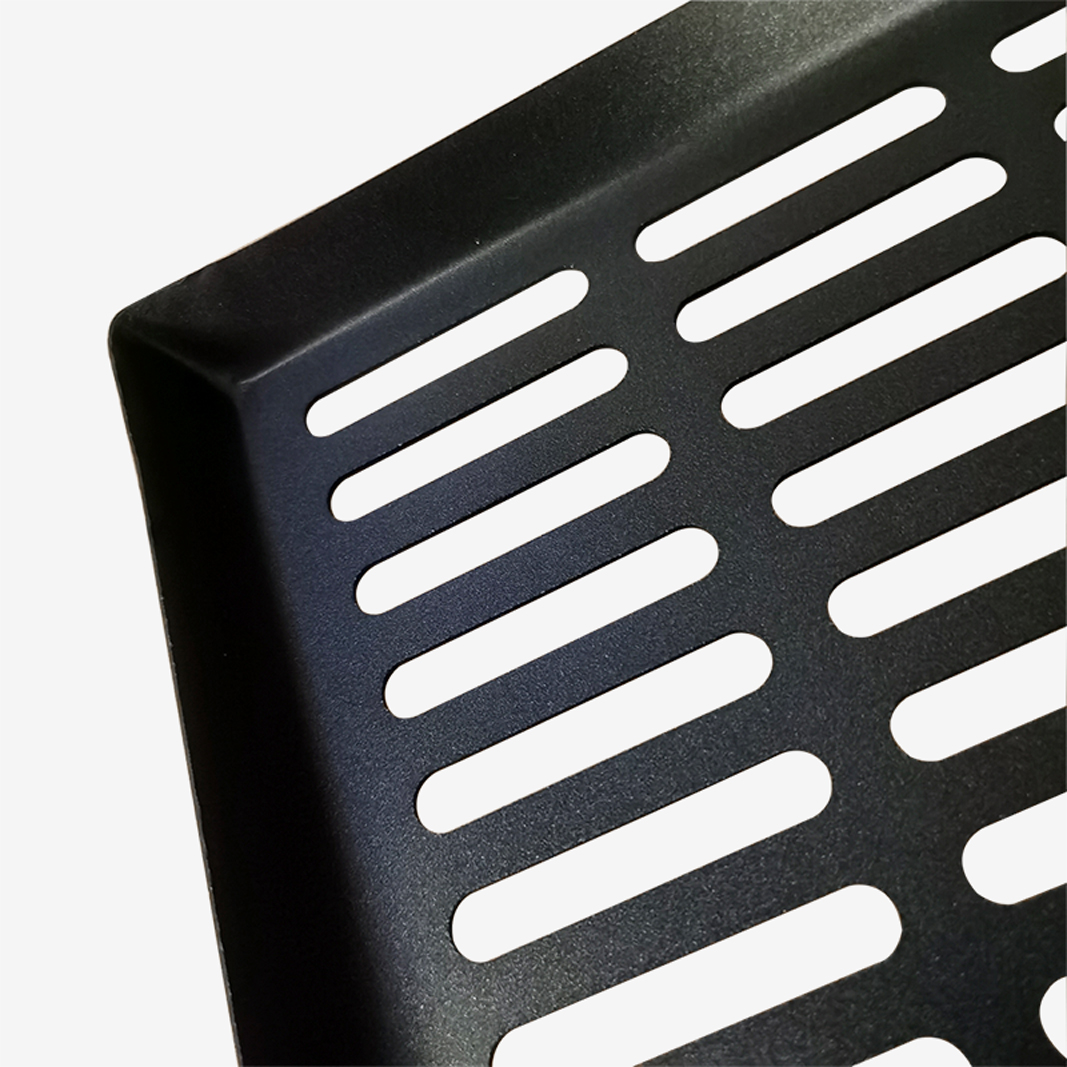
A coating is only as durable as the metal substrate beneath it. The structural design of your trays heavily alters how coatings adhere. Pan geometry dictates wear patterns and moisture release capabilities.
Evaluation requires a close look at structural stress points. On a right angle baking tray, sharp 90-degree corners create significant vulnerabilities. Liquid coatings often pool in these corners during manufacturing.
This pooling creates thick, brittle zones. These corners often chip first during rapid commercial stacking. When purchasing, look for reinforced corner designs. Ensure the manufacturer guarantees even, micron-level coating distribution across sharp angles.
Holes completely disrupt the continuous surface tension of a non-stick coating. On a perforated baking sheet, every single punched hole creates an exposed edge.
You must rigorously assess how the manufacturer seals the inner rims of these perforations. Properly sealed rims prevent moisture penetration. This stops rust and flaking at the micro-level. Quality rim sealing allows you to maintain optimal heat penetration without sacrificing coating integrity.
Vents serve a critical purpose in specific dough applications. A vented baking sheet channels excess moisture directly away from the product base. This ensures a crispy bottom crust.
However, this venting action forces high-temperature steam across the coated edges. The chosen non-stick coating must be highly resistant to steam degradation. Constant vapor pressure easily causes inferior laminations to bubble and peel over time. Always specify steam-resistant commercial coatings for vented geometries.
Food safety compliance drives modern procurement. You cannot sacrifice regulatory standards for cost savings. Operating with degraded coatings invites chemical contamination and severe health inspection penalties.
Commercial kitchens must adhere strictly to established safety expectations. The FDA and the SFA (Singapore Food Agency) heavily regulate food-contact materials. Modern compliance demands strict verification.
You must emphasize the necessity of PFOA-free certifications. Legacy coatings used harmful perfluorooctanoic acid. Today, reputable manufacturers provide safety datasheets confirming their PTFE or ceramic layers meet current global health benchmarks.
Kitchen staff often struggle to differentiate between normal use and critical failure. You must train teams to evaluate pan safety objectively. Use these criteria to spot functional failure:
Cosmetic Discoloration: Light brown or yellow tinting represents normal oil polymerization. This is entirely safe and expected.
Surface Scuffing: Minor, superficial scratches that do not penetrate to the bare metal are generally safe to continue using.
Flaking: If you see visible metallic chips or dark flakes shedding onto food, this is a critical functional failure. Discard the pan immediately.
Substrate Exposure: When the silver aluminum or steel base becomes widely visible through the coating, the pan has lost its non-stick integrity and regulatory compliance.
A massive conflict exists between aggressive dishwashing chemicals and coating longevity. Commercial dishwashers rely on high-pH, highly alkaline detergents to strip grease. These exact chemicals aggressively degrade silicone and PTFE matrices.
You must highlight this wash-station risk to management. Accurate ROI calculations require you to establish strict wash protocols. Hand-washing or the mandatory use of pH-neutral detergents are required assumptions. If your kitchen insists on using caustic dishwashers, you must forecast a drastically shortened pan lifespan.
Procurement fails when buyers purchase generically. You must tailor your pan selection directly to the specific daily workflows of your kitchen.
Start by auditing your oven temperatures. Are these pans exclusively used for 350°F ambient baking? Or do they frequently endure 450°F+ high-heat roasting?
Match your thermal limits to your menu. A high-sugar cookie bakery thrives on PTFE at 350°F. A busy steakhouse roasting vegetables at 500°F will destroy that same PTFE pan in days. The steakhouse needs ceramic or bare seasoned steel.
Examine how your line cooks operate. Rapid, aggressive plating environments heavily impact pan life. If your kitchen relies on metal spatulas, tongs, and heavy stacking, you must adapt.
Under heavy utensil abuse, prioritize ceramic coatings. Alternatively, pivot entirely to uncoated, seasoned carbon steel. Traditional PTFE simply cannot survive a metal-utensil workflow, regardless of the manufacturer's promises.
Effective budgeting requires mapped replacement cycles. You must calculate economic viability based on expected death rates of the pans.
Determine whether it makes more sense to buy moderately priced silicone-glazed pans that you routinely replace every quarter. Contrast this against buying premium PTFE pans that survive a full year. The correct answer depends on your local labor rates and specific volume requirements.
The concept of a universally "best" commercial non-stick tray does not exist in a vacuum. The ideal pan is the one that perfectly aligns with your kitchen’s thermal limits, dishwashing realities, and budget cycles.
Before initiating your next procurement cycle, decision-makers must audit their current inventory. Go inspect your pan graveyard. Identify the primary cause of failure. Are pans dying from deep scratching, or are they failing due to invisible carbon buildup?
To optimize your next purchase, follow these steps:
Audit maximum oven temperatures used on your current menu.
Review dishwashing detergent pH levels with your chemical supplier.
Ban metal utensils on all coated baking lines.
Select specific geometries, like vented or right-angle designs, based on the dough type.
A: Constant thermal cycling, highly alkaline commercial detergents, and high-frequency stacking abrasion rapidly break down coatings. Domestic pans rarely encounter these harsh variables. The volume of daily heat cycles in a bakery accelerates material degradation exponentially.
A: Commercial recoating services certainly exist. However, stripping a perforated design is notoriously difficult due to the complex hole geometry. Often, the labor outpaces the value. Replacing the tray entirely usually makes better economic sense for perforated models.
A: Both are strictly FDA-approved for food contact when kept within their designated temperature ranges. Your choice depends entirely on your baking application. Provided they meet modern PFOA-free guidelines, neither holds a definitive safety advantage over the other.


