
English


Views: 0 Author: Site Editor Publish Time: 2026-08-08 Origin: Site


Commercial baking operations face critical stakes every single day. Premature pan wear leads directly to unacceptable product loss. We see this happen when delicate dough sticks and tears upon removal. This failure also triggers increased cleaning downtime. Facilities ultimately face much higher replacement costs over time. We designed this guide to help you evaluate different surface options. We also cover strict longevity practices and tailored equipment solutions.
We must maintain an objective tone when evaluating equipment. No single surface treatment works perfectly for every application. The right choice always depends on strict temperature limits. You must also consider product acidity and your daily production volume. High-volume bread lines require different tools than boutique pastry shops. We will explore these specific variables below.
You will learn how to identify the best materials for your needs. We explain how to prevent common maintenance errors that destroy equipment. You will also discover how specialized pans improve overall workflow. Our goal is to help you maximize your operational efficiency.
The optimal baking tray coating depends heavily on release requirements (e.g., high-sugar vs. high-fat doughs) and operating temperatures.
Upgrading to a specialized non stick baking tray reduces labor costs associated with greasing and intensive scraping.
Standard sizes often leave dead space in commercial ovens; custom baking trays maximize throughput and ensure exact rack fitment.
Extending tray lifespan requires strict adherence to thermal shock prevention and the elimination of abrasive cleaning tools.
Achieving consistent yield is a primary goal for any bakery. Uniform release prevents delicate pastries from tearing during extraction. You ensure a higher percentage of sellable goods per batch. We know commercial bakery margins remain tight year after year. Every ruined croissant or torn bun impacts your profitability. A reliable non stick baking tray eliminates friction during the depanning process. Workers can transfer baked items faster and much more safely.
You will also notice immediate labor and material savings. Quality pans allow you to slash consumable costs significantly. You eliminate the need to purchase expensive parchment paper rolls. You can stop buying costly aerosol oil sprays entirely. They also remove the intense manual labor required for scrubbing. Staff no longer need to chisel baked-on carbon from raw metal. They can spend their time on profitable prep work instead.
Improved heat distribution serves as another major operational benefit. High-quality coated pans offer tremendous thermal consistency across the surface. Aluminized steel pans with protective layers conduct heat beautifully. You avoid the notorious hot spots common on heavily greased metal. They ensure evenly baked bottoms for every single pastry. Better thermal conductivity reduces your overall baking time slightly. This translates to higher throughput during a busy shift.
Understanding surface chemistry helps you make smarter purchasing decisions. PTFE (commonly known as Teflon) provides exceptional release properties. They handle sticky, high-sugar doughs perfectly. However, they carry strict temperature limitations you must respect. PTFE generally degrades quickly above 500°F (260°C). You also face regulatory compliance concerns if the surface scratches deeply. PFA and FEP coatings offer slightly better durability for industrial lines. They resist harsh chemical environments better than standard PTFE.
Silicone glaze remains the absolute commercial bakery standard today. Facilities use it heavily for basic bread and bun pans. It offers reliable release for low-sugar, high-fat doughs. However, it requires periodic recoating to remain effective. You must treat this as an ongoing operational expense. It is never a permanent feature on your pans. You will need to strip and reglaze them on a predictable cycle.
Ceramic options utilize advanced sol-gel technology for their finish. They boast exceptionally high heat tolerance for high-temperature roasting. Many operators perceive them as a greener, cleaner alternative. They resist physical scratches better than traditional polymers. However, their non-stick properties degrade faster under heavy commercial volume. You might find items sticking sooner than they would on PTFE. You must weigh this specific trade-off carefully.
Carbon steel provides an entirely different alternative approach. Some traditional bakers prefer its extreme, uncompromising durability. Bare carbon steel requires rigorous initial seasoning before use. You must build and maintain a natural polymerized layer. It demands intense, ongoing maintenance from your staff. The trade-off is a rugged pan you almost never throw away. You simply re-season it when the surface begins to fail.
By comparing these materials, you can match the right baking tray coating to your exact menu.
Coating Type | Best Application | Max Temperature | Durability Profile |
|---|---|---|---|
PTFE / PFA | High-sugar pastries, sticky buns | 500°F (260°C) | Prone to scratching, excellent release |
Silicone Glaze | Standard bread, rolls, buns | 450°F (232°C) | Requires regular reglazing cycles |
Ceramic (Sol-Gel) | High-heat roasting, savory bakes | 600°F+ (315°C+) | Highly scratch-resistant, fading release |
Carbon Steel | Artisan breads, heavy roasting | 600°F+ (315°C+) | Extreme durability, high maintenance |
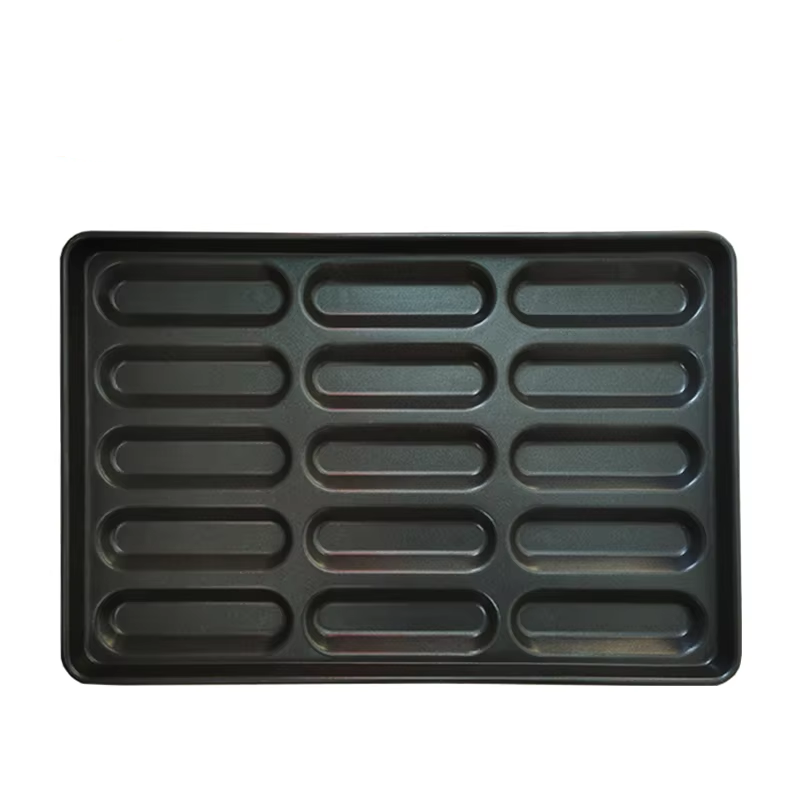
Off-the-shelf equipment often limits your true production potential. Standard sizes frequently leave dead space inside large commercial ovens. They also feature mismatched dimensions for automated production lines. Robotic depanners require exact tolerances to function without jamming. You lose valuable throughput capacity when pans do not fit perfectly. Standard pans force you to adapt your process to the tool.
Material and gauge specifications matter greatly in industrial settings. You must specify the exact metal thickness for your facility. We refer to this thickness as the gauge. Selecting 16-gauge or 18-gauge aluminized steel prevents long-term warping. Heavy gauges resist buckling under continuous high heat cycles. Thin commercial pans warp easily, causing uneven baking and product pooling.
Ordering custom baking trays gives you distinct competitive advantages. Buyers can match the exact release treatment to their food product. Highly acidic fruit tarts require different protection than standard pizza dough. Acidity can eat through cheap glazes very quickly. Custom manufacturing ensures your pans survive your specific recipes.
How do you evaluate custom manufacturers effectively?
Assess upfront tooling costs against your expected production volume.
Verify their minimum order quantities fit your budget.
Request rapid prototyping capabilities before committing to large runs.
Check their internal quality control and metal stamping standards.
Thermal shock remains the fastest way to destroy bakery equipment. We see this specific user error constantly in busy kitchens. Workers mistakenly submerge extremely hot metal into cold sink water. This rapid temperature shift causes immediate, severe metal warping. It also leads to instant surface delamination. The protective layer literally pops right off the metal base. You must let pans cool naturally at room temperature.
Safe cleaning protocols protect your equipment investment daily. Staff must understand exactly how to handle coated surfaces safely.
Do use soft sponges: Gentle agitation removes debris without causing microscopic scratches.
Do apply mild detergents: Keep the pH balance between 6 and 8.
Do wash in warm water: Warm water loosens fats gently.
Don't use steel wool: Abrasive pads destroy protective layers permanently in seconds.
Don't allow metal scrapers: Use rigid plastic dough scrapers instead.
Don't apply caustic degreasers: Harsh industrial chemicals strip release treatments instantly.
Proper physical storage prevents unnecessary damage between baking shifts. Storage damage happens incredibly fast when staff rush during closing. Nesting pans directly on top of each other causes deep scratches. The sharp bottom edge of one pan gouges the surface below. We highly recommend using dedicated, spaced racking systems. If you absolutely must stack them, use physical barriers. Place parchment inserts between each layer to prevent metal-on-metal contact.
You must carefully assess your primary culinary output first. High-sugar items demand heavy-duty PTFE or industrial silicone treatments. Sugar caramelizes and acts like superglue on bare metal. High-heat savory roasting needs ceramic finishes or seasoned carbon steel. You cannot use the exact same pan for both applications successfully. Match the specific tool to the exact recipe profile.
We encourage buyers to audit their current failure rates carefully. Count exactly how many pans you discard or ruin monthly. Analyze where the failures happen most frequently in your kitchen. Consult with a specialized manufacturer directly about your unique pain points. You should always spec a prototype before a bulk facility rollout. Test the prototype rigorously under normal kitchen stress.
The right baking pan functions as vital production equipment. It directly impacts your bottom line every single shift. It is never just a static, disposable kitchen tool. A tailored approach prevents unnecessary downtime and speeds up production.
Pairing the correct surface with strict maintenance protocols is essential. This remains the only verifiable way to achieve high equipment longevity. You protect your capital investment daily through proper staff training. Prevent thermal shock and ban abrasive tools from your sinks.
Evaluate your current kitchen workflows and failure rates today. Request a formal consultation for custom-fit solutions to optimize your bakery. Upgrading your equipment will transform your daily operations completely.
A: Lifespans vary wildly based on volume and cleaning methods. High-volume bakeries might degrade a silicone glaze in six months. Careful handling extends PTFE surfaces to over a year. Harsh scrubbing and thermal shock can destroy any finish in weeks. Plan for periodic recoating cycles to maintain optimal performance.
A: It depends on the type of pan. You should immediately discard cheap home pans with deep scratches. However, commercial silicone-glazed pans are designed for repair. Manufacturers can professionally strip the old layer away. They clean the bare metal and apply a fresh, perfectly smooth glaze.
A: Yes, they frequently pay for themselves within months. Custom pans maximize your specific oven footprint entirely. You bake more units per rack, increasing daily throughput. They also reduce crippling product waste by ensuring perfect automated depanning. The long-term labor savings easily offset the initial tooling investment.
A: Never scrape the pan with metal tools or steel wool. We strongly recommend soaking the tray in warm water first. Use specialized, non-abrasive enzymatic cleaners designed for bakery equipment. These cleaners gently break down stubborn fats at a molecular level. You can then wipe the residue away with a soft sponge.


