
English


Views: 0 Author: Site Editor Publish Time: 2026-08-02 Origin: Site


Scaling a commercial bakery exposes the hidden costs of standardized tooling. You often find mismatched pan sizes and frequent replacements silently draining your margins. Everyday inefficiencies compound quickly on a large scale. While off-the-shelf pans serve entry-level needs well, high-volume production lines demand much more. High-capacity facilities require precise integration between dough specifications, racks, ovens, and baking pans.
Moving to specialized pan configurations is a major capital-expenditure decision. It shifts your primary focus from initial unit cost to long-term operational ROI. You must look beyond the basic price tag. This guide outlines how tailored setups eliminate frustrating production bottlenecks. We will also provide a clear framework for evaluating manufacturer capabilities and maximizing your facility's daily output.
Custom baking trays optimize oven and rack capacity, often increasing yield-per-bake by eliminating dead space.
Tailored materials and proprietary non-stick coatings reduce depanning times and eliminate the recurring cost of release agents.
Engineering trays for specific automation systems (conveyors, depanners) prevents line jams and reduces equipment wear.
Procuring custom bakery equipment requires balancing upfront tooling costs with long-term gains in durability and hygiene.
Many facilities initially rely on generic commercial baking trays to get production moving. Generic pans seem economical at first glance. However, mass-produced bakeware introduces micro-inefficiencies across the production floor. These small issues scale into massive bottlenecks during high-volume operations.
Standard sizes rarely offer a perfect mathematical match for specialized convection oven setups. They also often fail to fit custom bread trolleys perfectly. You might notice a few inches of empty space on every rack. This unused square footage accumulates during every single baking cycle. Over a busy month, this dead space translates to thousands of unbaked loaves or pastries. You essentially pay to heat empty air.
Off-the-shelf pans lack the precise engineering tolerances required for modern automated systems. Conveyor belts, automated stackers, and vacuum depanners require exact dimensions. Generic pans vary slightly in size or warp slightly after a few uses. This variance leads to costly line jams. Operators must then stop the entire production line to clear the jammed machinery. Such downtime destroys your daily production schedule.
Generic metal gauges do not cater to specific product needs. They often fail to match the unique heat transfer requirements of dense sourdoughs or delicate croissants. A thin aluminum pan might scorch the bottom of a heavy dough. Conversely, a thick pan might underbake a delicate pastry. These poor thermal dynamics result in uneven bakes. Inconsistent baking ultimately drives up your product rejection rates.
Standard pans often lack heavily reinforced structures. They usually omit encapsulated heavy-duty wire rims or hardened corners. Continuous high-temperature industrial use destroys these generic pans quickly. The metal warps, buckles, and bends under rapid heating and cooling cycles. Once a pan warps, it no longer sits flat on oven racks. You must then replace these pans frequently, burning through your maintenance budget.
Transitioning to custom baking trays transforms your bakery floor. Tailored solutions address specific pain points directly. They turn your pan inventory from a consumable expense into a strategic operational asset.
Custom dimensions are engineered backward from your existing oven racks and cooling trolleys. Engineers measure the exact inner dimensions of your equipment. They then design pans to fill every available millimeter. Eliminating just two inches of wasted space per rack can exponentially increase your daily output. You achieve this higher yield without consuming additional labor or energy. The ovens run the exact same cycle, but produce significantly more sellable product.
Standard pans require operators to spray release agents constantly. Specifying custom non-stick coatings solves this messy problem. You can choose advanced silicone or specialized fluoropolymers tailored specifically to your dough. The coating matches your specific sugar content and dough hydration levels. This strategic match completely removes oil-spraying steps from your line. It speeds up depanning dramatically. Furthermore, eliminating aerosolized oils improves overall facility hygiene and reduces slip hazards.
Airflow dictates crust development in commercial baking. Custom perforation patterns are designed specifically for your exact product line. Baguettes require vastly different airflow than heavy rye breads. Engineers can customize the hole diameter and spacing on the pan surface. This precise perforation ensures proper crust development. It also reduces overall baking times in forced-air or convection environments. Faster bake times mean higher daily throughput.
Manual handling remains a reality in many bakeries. Customizing pan weights reduces physical strain on your operators. You can specify rolled grip edges to make lifting easier and safer. You can also engineer custom nesting capabilities into the design. Pans that nest perfectly optimize your valuable storage footprint. Better ergonomics lead to fewer workplace injuries and a more efficient staff.
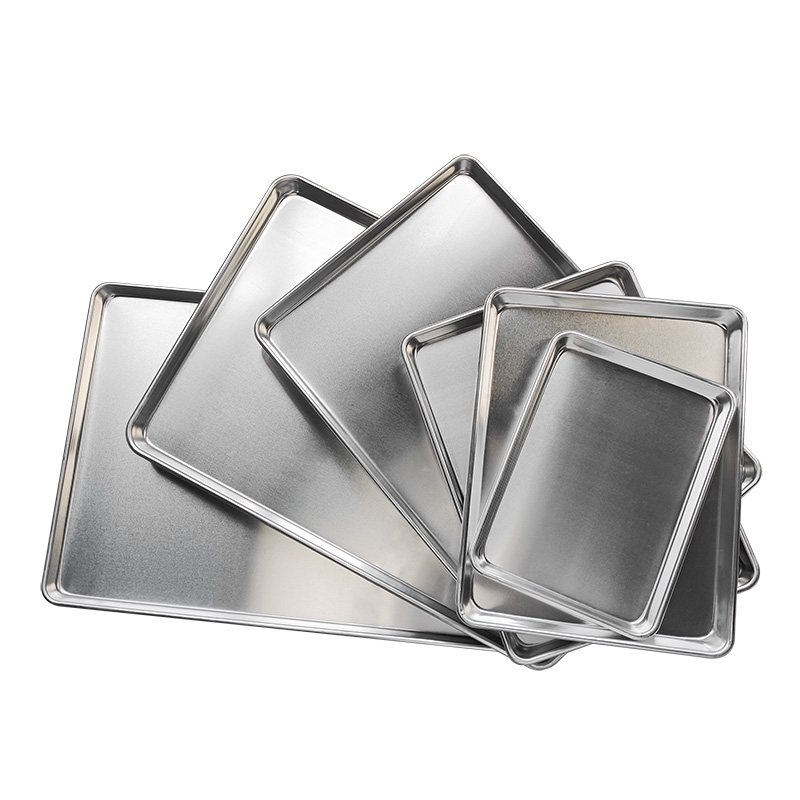
Selecting the right underlying material is crucial. The material dictates how heat transfers into your dough. The coating dictates how easily the finished product releases. You must balance these physical properties carefully.
Your base material choice directly impacts both pan longevity and bake quality. You must match the metal to your specific production environment.
Aluminized Steel: This is the premier choice for heavy-duty commercial environments. It provides maximum durability and incredible resistance to warping. The steel core offers immense strength. The aluminum coating prevents rusting. It is absolutely ideal for highly automated lines enduring physical stress.
Anodized Aluminum: This material offers superior heat conductivity. It excels during rapid heating and cooling cycles. It also weighs significantly less than steel. This lighter weight makes it perfect for facilities relying heavily on manual handling.
Coatings are not universally identical. You must evaluate coatings based on expected lifecycle counts. Some coatings offer extreme non-stick properties but wear out faster. Other coatings last longer but require slight greasing for high-sugar doughs.
Evaluate expected cycle counts before recoating becomes necessary. You might choose a glaze rated for 2,000 bakes or a premium polymer rated for 5,000 bakes.
Assess chemical compatibility carefully. Review your facility's specific sanitization protocols. Harsh caustic cleaners strip away delicate non-stick coatings rapidly. You must select a coating formulation resistant to your specific cleaning chemicals.
The physical geometry of the pan dictates its structural integrity. You must evaluate the necessity of seamless corners versus folded corners. Seamless corners provide superior hygiene because dough cannot get trapped in crevices. They also allow for much easier cleaning. However, seamless deep-drawn pans require expensive molds. Folded corners offer better cost-efficiency for tighter budgets. Additionally, you should determine the requirement for corrugated bottoms. Corrugation adds immense rigidity to large sheet pans. It also prevents flat breads from sticking by reducing surface contact area.
Material Type | Heat Conductivity | Warp Resistance | Best For |
|---|---|---|---|
Aluminized Steel | Moderate | Excellent | Automated lines, heavy doughs |
Anodized Aluminum | Excellent | Moderate | Manual handling, delicate pastries |
Stainless Steel | Low | Outstanding | High-acid foods, extreme durability |
Carbon Steel | Good | High | Specialty breads, high-temp baking |
Moving away from standard catalogs requires careful financial planning. You must understand the manufacturing process to project your returns accurately. Initial sticker shock often deters bakeries from upgrading. However, a deeper analysis reveals rapid payback periods.
Acknowledge that custom tooling requires a noticeable initial investment. Manufacturers must design CAD models and machine specific stamping molds for your unique pans. You cannot evaluate this solely on a per-pan cost basis. Instead, calculate your ROI based on operational improvements. Factor in the complete elimination of daily release oils. Calculate the reduction in labor hours previously spent scrubbing pans. Quantify the profit gained from lower scrap rates. Most facilities see a complete return on investment over a 24- to 36-month period.
Understand that custom manufacturing inherently requires scale. Factories cannot tool up machinery to produce just twenty bespoke pans. Define standard industry MOQs during your initial vendor discussions. Typical MOQs range from a few hundred to over a thousand units. You must plan your inventory acquisitions carefully. Order enough to cover your peak seasonal demand. Ensure you hold some safety stock for unexpected production spikes.
Never skip the sample testing phase under any circumstances. Rushing into mass production is a common, expensive mistake. Request prototype pans first. Run these prototypes through actual oven cycles in your facility. Test them rigorously on your automated depanners and conveyors. Verify the thermal performance matches your expectations perfectly. Confirm all dimensional tolerances hold up under heat. You must validate the design physically before authorizing the final mass production run.
Custom pans are long-term assets. You do not throw them away when the coating degrades. Factor in the logistics of stripping and recoating trays as part of your operational planning. Professional recoating restores the pans to factory-new condition. Plan these recoating cycles during slower production months. This maintenance strategy ensures continuous efficiency without forcing you to buy entirely new metal bases.
Success depends on how well you communicate with your manufacturing partner. Procuring bespoke bakery equipment requires deep collaboration. Manufacturers need exact operational data, not just rough sketches.
Provide highly specific data points regarding your facility environment. Note the exact oven types you operate. Detail the maximum and minimum temperature ranges the pans will endure. Explain your post-bake cooling methods. Are the pans exposed to flash freezing? Furthermore, document the exact chemical cleaning agents used by your sanitation team. This data prevents premature coating failures.
Your dough chemistry influences pan design heavily. Provide detailed dough weights for each product line. Document the hydration levels accurately. High-hydration doughs behave differently than stiff doughs during baking. State the exact sugar content percentages. High sugar creates aggressive sticking hazards. Finally, detail the expected expansion rates during proofing and baking. The manufacturer uses this data to recommend optimal pan depths, wall angles, and specialized coatings.
Conduct a thorough physical audit of your current hardware. Measure your existing proofing racks meticulously. Measure the runner spacing on your bread trolleys. Document the width and guardrail heights of your automated tracks. You must ensure the new custom trays integrate seamlessly across the entire production floor. A pan that bakes perfectly but jams the cooling conveyor is ultimately useless. Share these detailed mechanical blueprints with your pan manufacturer upfront.
Transitioning to custom baking configurations represents a highly strategic operational upgrade. It is definitely not just a routine procurement swap. Tailored pans solve root-cause production issues directly.
While initial tooling costs clearly exist, the compounding daily efficiencies validate the investment. You gain massive improvements in rack yield, labor allocation, and final product consistency. Scaling bakeries cannot afford the hidden friction of generic pans.
Your next step is clear. Conduct a rigorous yield-loss audit on your current standard pans this week. Identify exactly where generic sizing restricts your output. Then, request a dimensional and coating consultation with a specialized manufacturer to explore your true production potential.
A: Lead times generally range from 6 to 12 weeks. This timeframe factors in initial CAD design, custom tooling creation, and sample prototyping. Prototype testing alone can take two weeks. Once you approve the final samples, mass production and shipping consume the remaining weeks.
A: Yes, the upfront per-unit cost and initial tooling fees are higher. However, you recover this investment quickly. The ROI is typically realized within the first year through increased capacity per bake, eliminated release-agent costs, and drastically reduced manual labor.
A: Lifespan depends entirely on usage frequency, dough sugar content, and cleaning protocols. High-quality silicone glazes may last 500 to 2,000 cycles. Advanced fluoropolymer coatings can easily exceed 3,000 cycles before requiring any professional stripping and refurbishment.
A: Yes, achieving backward compatibility with existing bakery hardware is the primary reason commercial facilities commission custom trays. Exact measurements of your specific rack runners and oven chambers dictate the final engineering dimensions perfectly.


