
English


Views: 0 Author: Site Editor Publish Time: 2026-07-27 Origin: Site


Off-the-shelf bakeware often falls short in high-volume or specialized environments. These generic solutions quickly lead to warped pans, uneven bakes, and frequent replacement costs. Standard inventory simply cannot accommodate unique oven configurations or complex pastry requirements. Small dimension mismatches cause major headaches during automated loading sequences. Investing in custom baking trays bridges the critical gap between standard inventory limitations and exact operational requirements. You need tailored equipment to maximize yield and maintain rigid quality control daily. This guide provides an evidence-based framework for evaluating structural designs, metal materials, and surface coatings. We will explore how precise manufacturing ensures your trays deliver consistent bake quality. You will learn to navigate material thermodynamics and specify edge profiles confidently. Ultimately, this specific guidance ensures your final equipment specification supports heavy daily use and delivers an excellent long-term return on your initial investment.
Standard baking trays often lack the exact dimensions, gauge thickness, or specialized coatings required for optimized, high-volume production.
Material selection (Aluminum vs. Aluminized Steel) dictates heat transfer rates and tray lifespan, directly impacting operational costs.
Customization extends beyond size; edge styles, perforation patterns, and food-safe surface treatments must align with your specific product and cleaning protocols.
The right manufacturing partner should offer prototype testing to validate thermal performance before full-scale production.
Standard trays create immediate inefficiencies on the commercial production floor. Wasted oven rack space severely limits your daily batch yields. A generic pan might leave three inches of unused depth in your expensive rotary oven. You lose hundreds of potential units per shift due to this poor spatial fit. Inconsistent crust development frequently forces operators to discard perfectly good ingredients. Generic pans also suffer rapid physical degradation under harsh commercial washing conditions. They warp easily when exposed to sudden temperature changes. You need equipment built explicitly for your facility. A successful custom solution maximizes your available oven footprint seamlessly. It perfectly matches the specific thermal requirements of your proprietary dough or batter. Most importantly, it withstands aggressive handling by facility staff without bending or warping.
Many managers hold a stubborn misconception regarding custom engineering. They assume specialized tooling is inherently cost-prohibitive for mid-sized operations. However, precision equipment yields highly measurable operational value over time. You experience drastically reduced replacement frequency over several years. You also see significantly lower defect rates during daily quality checks. Precision engineering removes the costly guesswork from your bake times. Transitioning to custom equipment requires careful attention to implementation reality. You must recalibrate your bake times immediately upon receiving new inventory. Changes in material thickness naturally alter oven heat dynamics. Modified airflow patterns change how moisture escapes the product. You must test and adjust oven parameters to maintain your established quality standards.
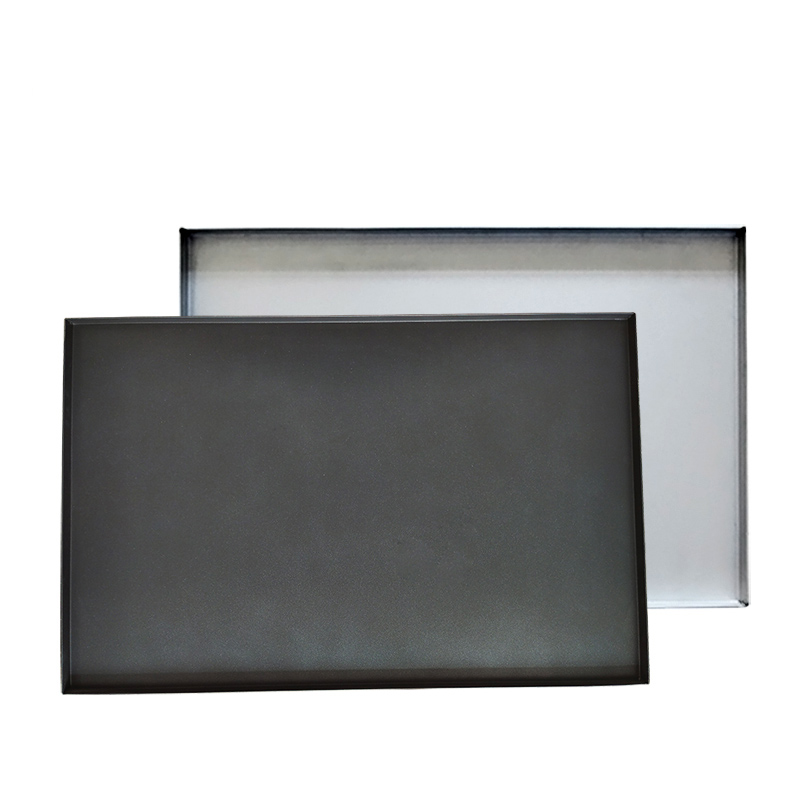
Evaluating different baking tray types is critical for production alignment. Each physical format serves a specific thermal and structural purpose. We rely on distinct designs to manage moisture release and crust formation effectively. Using the wrong format ruins product texture.
Flat Sheet Pans (Solid): These remain best for liquid batters, delicate cookies, and laminated items. You need them when requiring maximum heat retention from the oven deck. They provide a perfectly flat spread for liquid-heavy recipes. Customization focuses heavily on rim structure and precise metal gauge. Reinforcing the edges prevents the pan from twisting under high heat.
Perforated Trays: Engineers design these specifically for optimal bottom airflow. They work best for rustic breads, dense pastries, and par-baked goods. These items require rapid crust development to trap internal steam properly. Customization focuses on exact hole diameter and grid spacing. You must size the perforations correctly to prevent wet dough extrusion.
Corrugated/Fluted Trays: This unique design adds substantial structural rigidity to the metal sheet. It also creates specific, highly desirable bottom textures on baked goods. We strongly recommend them for heavy-duty applications. Flat pans often fail and warp in these exact environments. The ridges allow air to circulate slightly underneath the heavy product.
Baguette / Specialized Molds: These deep-drawn or channel trays cater precisely to exact dough weights. You use them to maintain uniform shapes during the crucial proofing phase. Sourcing specialized custom baking trays ensures your specialty breads never flatten out. The channels support the dough walls while conducting heat directly into the center.
Aluminized steel remains the undisputed industry standard for heavy-duty commercial use. It boasts exceptional mechanical strength and robust corrosion resistance. It firmly holds its exact shape under extreme high heat environments. You will rarely see these pans warp under normal commercial conditions. However, you must carefully consider its operational drawbacks. It is considerably heavier for your floor staff to lift manually. It also heats and cools much slower than raw aluminum. This thermal lag can cause residual baking after you remove racks from the oven.
Anodized aluminum offers incredibly rapid heat transfer. It remains highly favored because it is exceptionally lightweight. The specialized anodization process successfully resists acidic reactions. This unique trait proves crucial for specific fruit-based tarts or highly acidic bakes. Lemon bars will pit standard aluminum, but anodized surfaces resist this damage. On the downside, aluminum is fundamentally a softer metal. It remains far more susceptible to dents and scratches during washing. You must specify a heavy gauge to compensate for this inherent softness.
Stainless steel provides maximum physical durability in harsh commercial environments. It ensures rigorous sanitation compliance in highly regulated food facilities. It resists deep scratching and aggressively acidic cleaning chemicals effortlessly. Yet, it suffers from notably poor heat conductivity. You face a high risk of uneven baking across the pan surface. We advise against pure stainless steel unless you layer it with a conductive aluminum core.
Gauge thickness plays a pivotal role in this engineering trade-off. Lower gauge numbers indicate significantly thicker metal. Thicker metal actively prevents warping during rapid temperature shifts. However, this extra mass inevitably requires longer bake times. The 18-gauge to 22-gauge range serves as the standard evaluation window for commercial buyers.
Material Performance Comparison
Material Base | Thermal Conductivity | Mechanical Durability | Ideal Bakery Application |
|---|---|---|---|
Aluminized Steel | Moderate | Exceptional | High-volume breads, automated machinery handling |
Anodized Aluminum | Excellent | Moderate | Delicate pastries, fruit-based acidic bakes |
Stainless Steel | Poor | Maximum | Medical-grade sanitation, extreme chemical wash cycles |
Uncoated or natural finishes require strict daily seasoning. You must use regular greasing protocols or expensive parchment paper inserts. This raw approach works best for highly abrasive manufacturing environments. Harsh scraping tools would rapidly destroy delicate chemical coatings here. Natural finishes demand more manual labor during the daily preparation phase. You trade higher labor costs for extreme pan longevity.
Silicone glaze offers excellent initial release properties. We often recommend it for high-sugar recipes prone to severe sticking. It allows delicate cakes to drop out perfectly intact. However, you must accept its inherent mechanical limitations. It has a strictly finite lifespan, typically lasting only a few hundred bakes. It also degrades rapidly under harsh alkaline cleaning chemicals. Your sanitation team must use mild, pH-neutral detergents to protect the glaze.
PTFE coatings provide vastly superior longevity. They offer impressive slickness compared to standard silicone glaze. They withstand higher friction during automated demolding processes easily. Regulatory compliance remains mandatory here. You must rigorously verify FDA or NSF compliance for direct food contact. The coating must remain stable at your intended operational temperatures. Overheating PTFE poses significant facility risks and releases harmful compounds.
Transparency regarding facility maintenance is absolutely essential. All commercial surface coatings eventually fail and degrade. Your evaluation matrix must factor in the recurring cost of commercial re-glazing. Sometimes, buying raw pans and applying liquid release agents daily makes better financial sense. You must run a strict comparative analysis for your specific production volume.
Choosing the right equipment demands a strictly systematic approach. You must evaluate several technical criteria to ensure true operational success. Guesswork leads to jammed conveyor belts and ruined product batches.
Dimensional Accuracy: Measure your exact internal oven clearances personally. Check rack spacing and automated conveyor widths very carefully. Do not rely on nominal standard sizes like "Full Size" designations. Commercial manufacturing tolerances vary wildly between different global brands. A fraction of an inch causes automated loaders to jam entirely.
Structural Integrity Add-ons: Evaluate the necessity of reinforced wire-in-rims. Consider adding heavy-duty bandings or closed sanitary corners. These specialized additions actively prevent hidden hygiene traps. They stop dirty water from pooling inside the rim during washing. They also stop the entire pan from warping under heavy product loads.
Supplier Vetting & Prototyping: Never commit to a high-volume custom order blindly. You must always insist on testing a physical prototype first. Test this prototype for heat distribution by baking a strict control batch. Verify the mechanical fit directly. Run it physically through your automated washers and loading racks to check clearances.
Shortlisting Logic: Base your final vendor selection on a comprehensive, weighted matrix. Factor in thermal performance data gathered directly from your prototype. Compare the per-unit replacement cost across different specialized vendors. Evaluate the Minimum Order Quantity requirements carefully. Finally, confirm realistic delivery lead times for large future shipments.
Specifying tailored bakeware is a critical engineering decision, not just a simple procurement task. Success requires carefully balancing material thermodynamics with everyday mechanical durability. Standard inventory pans simply cannot match the precise tolerances required for optimized commercial baking. You must align your equipment with your exact facility requirements to prevent daily product loss.
Audit your current equipment failure points immediately. Look for persistent warping, sticking issues, or inefficient rack spacing limits. Document these specific operational inefficiencies clearly. Next, request a thorough material consultation from a highly qualified equipment manufacturer. Finally, order a single test prototype. Use it to validate your assumed heat transfer rates before scaling up your final production line.
A: MOQs vary heavily depending on the manufacturer and the custom design complexity. They often range from 50 to over 500 units per order. Custom stamping dies require significant upfront setup time and engineering labor. This high threshold directly impacts feasibility for smaller boutique operations. Always ask specific suppliers about tiered pricing for higher volumes.
A: A realistic lifespan heavily depends on the specific material gauge and your daily washing practices. Heavy-duty aluminized steel can last several years under normal handling conditions. However, non-stick surface coatings always fail long before the actual metal degrades. You can expect a standard silicone glaze to last roughly 300 to 800 bake cycles.
A: Yes, commercial re-glazing is a very common industry practice. Facilities strip off the degraded coating entirely and apply a fresh layer. It becomes economically viable when the underlying heavy-gauge metal remains perfectly straight and undamaged. Re-coating costs significantly less than purchasing brand new custom metal pans from the manufacturer.
A: Yes, modifying the metal thickness absolutely affects your core recipe. Changing the thermal mass directly alters how quickly heat transfers into your dough. Lower gauge pans require slightly longer bake times or higher oven temperatures. You must perform immediate recalibration to avoid accidentally over-baking or under-baking your standard products.


