
English


Views: 0 Author: Site Editor Publish Time: 2026-10-27 Origin: Site


In a high-volume bakery or commercial kitchen, oven trolleys are not just storage. They act as critical workflow components. Staff subject them to extreme thermal shock and heavy loads every single day. Poor equipment selection often yields disastrous operational results. Premature weld failure compromises structural integrity mid-shift. Melted casters halt production lines entirely. Warped runners create severe workflow bottlenecks and serious safety hazards for your staff.
Our objective here is very clear. We provide a strict, evidence-based evaluation framework. We want to help commercial buyers select durable, compliant oven trolleys. These units must align perfectly to your specific oven types. They must also match your daily production scales. You will learn exactly how to evaluate materials, structural joints, and critical mobility features to ensure a successful equipment upgrade.
Material dictates lifespan: 304-grade stainless steel resists corrosion and heat warping significantly better than aluminum or lower-grade alloys.
Casters are the primary failure point: Only high-temperature phenolic or specialized resin wheels survive daily roll-in oven cycles.
Compatibility is non-negotiable: Runner spacing and trolley dimensions must perfectly match your specific commercial baking sheet pans and oven lifting mechanisms.
TCO over upfront cost: Cheaper trolleys often require annual replacement; investing in fully welded construction reduces Total Cost of Ownership.
Equipment mismatch creates immediate, cascading failures across a busy kitchen. Warped runners or jammed wheels halt production during peak hours. When a wheel seizes in front of an oven, staff must drag a fully loaded cart. This damages expensive flooring and slows down batch transitions. Time lost during these transitions directly reduces your daily yield.
Safety and compliance risks also escalate rapidly. Tipping loads pose a massive threat. Hot pans sliding off unbalanced runners cause severe burns and ruin expensive ingredients. You must rely on food-safe, easily sanitizable materials. Equipment should carry relevant sanitation compliance certifications like NSF. Bare metal lacking proper finishing harbors bacteria in its crevices.
Be highly skeptical of the "heavy-duty" trap. Marketers frequently use vague "heavy-duty" claims to sell flimsy products. You should always insist on verifiable metal gauge ratings. Demand exact load capacities. If a supplier cannot state the maximum weight limit per tier, do not purchase the unit. A true industrial cart provides transparent structural data.
Material selection completely dictates equipment lifespan. Aluminum remains strictly for ambient storage or cooling use. It is lightweight and highly affordable. However, aluminum warps severely under high heat. You need a stainless steel baking tray trolley for direct high-heat applications. Within stainless options, you must evaluate the grades carefully. The 304-grade stainless steel contains higher nickel content than 201-grade. This makes 304 highly resistant to corrosion from moisture, steam, and acidic food residues.
Material Suitability Comparison Chart
Material Type | Primary Kitchen Use | Heat Tolerance | Corrosion Resistance |
|---|---|---|---|
Aluminum | Cooling, Proofing, Storage | Low (Warps easily) | Moderate |
201 Stainless Steel | Light Baking, Prep | High | Low to Moderate (Prone to rust) |
304 Stainless Steel | Heavy Daily Baking | Excellent | Exceptional (Food-safe) |
Next, you must evaluate the joints. We constantly see structural vulnerability in bolted or riveted racks. Metals undergo continuous thermal expansion and contraction inside an oven. Fasteners loosen over time under this repeated stress. You should always recommend fully welded frames for daily roll-in oven use. A welded joint fuses the metal permanently, eliminating weak points.
Gauge thickness finalizes structural integrity. Standardize your expectation for metal thickness. Lower gauge numbers mean thicker metal. Choose 16-gauge or 18-gauge steel to prevent frame distortion under heavy loads. A 20-gauge frame will twist when loaded fully with dense dough products.
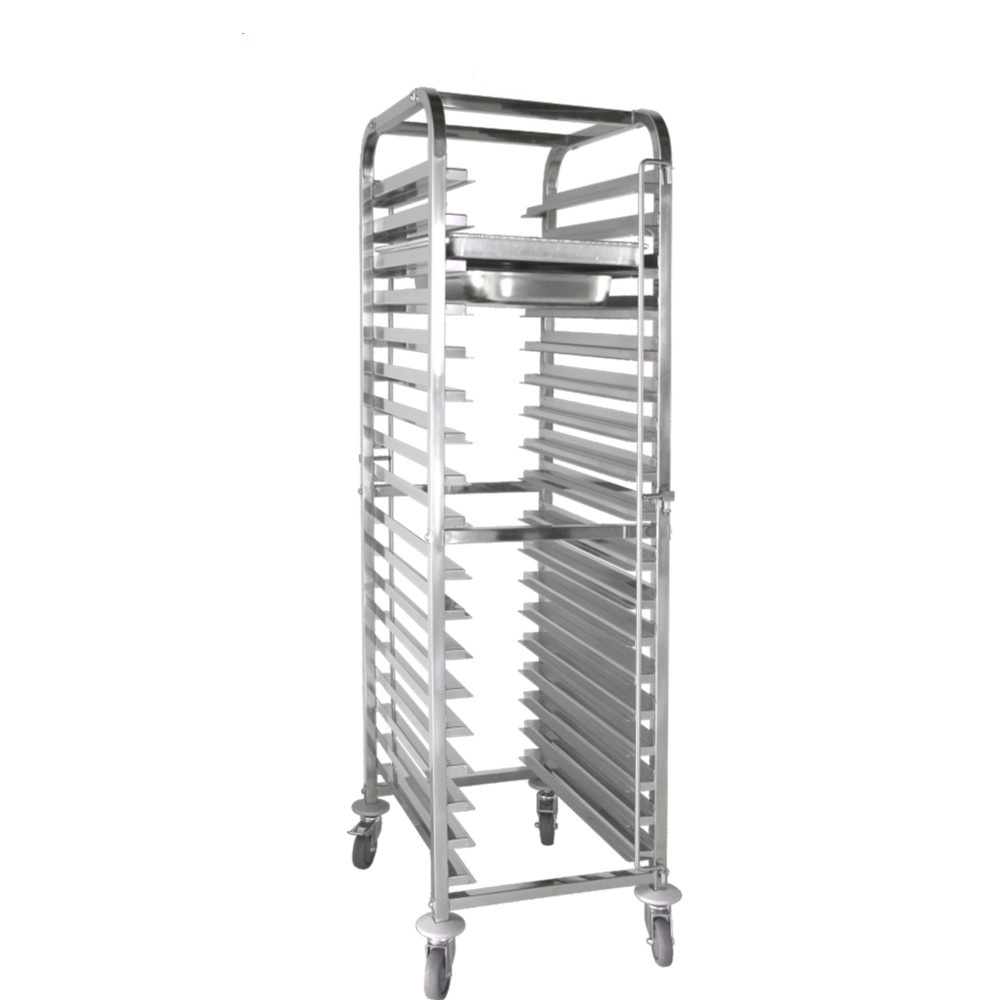
Precision sizing prevents dangerous accidents and product loss. You must evaluate runner spacing carefully. A 3-inch gap suits flat products like cookies or macarons. A 4-inch or 5-inch gap accommodates artisan breads and tall pastries. Ensure the trolley safely seats standard commercial baking sheet pans. Full-size 18"x26" or Gastronorm GN 1/1 sizes must slide in without any lateral slippage. A loose fit causes pans to drop through the runners.
Oven integration dictates the exterior dimensions. Roll-in convection ovens require standard base dimensions. Rotary rack ovens demand highly specialized integrations. You must assess the lifting mechanism carefully.
Top Lifting Hook: The crossbar must align precisely with the oven's rotating hoist.
Bottom Locking Mechanism: The base frame must engage the floor turntable securely.
Clearance Height: The top tier must clear the inner ceiling fan during rotation.
Failure to match these specifications results in immediate equipment damage. A mismatched cart can jam a rotary oven mechanism, causing thousands of dollars in repairs.
Casters represent the most common failure point. Standard rubber or polyurethane wheels melt into puddles inside a hot oven. At best, they develop permanent flat spots after one bake cycle. You must specify high-temp phenolic wheels. Manufacturers rate these specialized wheels to withstand continuous temperatures of at least 500°F (260°C). Some advanced resin options tolerate even higher peaks.
You cannot ignore bearing and grease specifications. Standard grease vaporizes or bakes into a hard, useless crust inside an oven. Bearings quickly seize, locking the wheels completely. You must demand high-temperature, food-grade grease in the caster bearings. This keeps wheels turning smoothly after hundreds of repeated bake cycles.
Brake configurations require careful thought. Kitchen floors often slope toward drains. You need locking casters for safe loading and unloading on uneven floors. We recommend placing brakes on at least two wheels. This prevents a heavy cart from rolling away while staff maneuver hot pans.
Modern kitchens demand versatile equipment. Carts experience violent temperature changes daily. They move directly from a 450°F oven to a -10°F blast chiller. This rapid transition tests thermal shock resistance. Weak joints snap under this extreme contraction. Only high-grade, fully welded stainless steel survives this daily punishment without structural compromise.
Smart operators standardize trolley sizes across their entire facility. They ensure their baking Oven Trolleys seamlessly transition into the role of commercial cooling racks. This eliminates the need to transfer hot products between different pans or carts. Staff simply roll the unit out of the oven and into the ambient staging area. This multipurpose workflow approach saves countless labor hours each week.
You must scrutinize vendors just as closely as their products. Assess vendors based on their warranty terms. Specifically, look for clauses covering weld integrity and caster durability. A warranty excluding wheels is often useless in a bakery setting. Reliable manufacturers stand behind their high-temp casters and welded joints unconditionally.
Operators frequently debate between custom and off-the-shelf options. Standardized models ship fast and cost less. However, older or specialized ovens often require exact dimensions. In these cases, you can easily justify the lead time and premium price for custom-built commercial oven trolleys. Modifying an off-the-shelf unit in your own shop usually voids the warranty and compromises structural safety.
Implement this shortlisting action plan when approaching suppliers:
Audit current oven mechanisms. Measure exact clearance heights, hook styles, and turntable locks.
Define maximum load capacity. Calculate the heaviest product batch you produce per trolley.
Request material specification sheets. Ignore glossy brochures. Demand the engineering spec sheet proving 304-grade steel and phenolic caster ratings.
Selecting the right cart protects your daily output. Prioritize high-temp phenolic casters above all other mobility features. Demand the appropriate stainless steel gauge to prevent frame distortion. Ensure exact dimensional compatibility with your existing pans and ovens. Treat this equipment as a direct extension of the oven itself. A carefully researched purchase protects your staff safety, maintains production speed, and preserves your capital budget for years.
A: Standard capacities range from 300 lbs to over 800 lbs. The exact limit depends entirely on the metal gauge and the caster load ratings. Fully welded 16-gauge stainless steel units typically handle the highest weight classes without bending.
A: No. Aluminum warps and structurally degrades under intense baking temperatures. It poses a severe safety hazard inside an oven. You must restrict aluminum trolleys strictly to cooling, proofing, or ambient storage applications.
A: You should inspect casters monthly. High-volume bakeries typically replace phenolic wheels every 12 to 18 months. You must reapply high-temperature food-grade grease to the bearings every few months to prevent premature seizing.
A: End-load trolleys hold pans lengthwise, making the cart narrower and easier to push down tight aisles. Side-load trolleys hold pans sideways, making the cart wider but shorter in depth. Your choice depends entirely on your specific oven depth and kitchen aisle space.


