
English


Views: 0 Author: Site Editor Publish Time: 2026-10-20 Origin: Site


Achieving the signature crisp, shatter-prone crust of a traditional French baguette requires precise management of heat and moisture during the bake. Without proper airflow, bakery-level perfection remains largely out of reach. Solid baking surfaces often trap steam directly beneath the dough. You will quickly notice uneven browning, soft bottoms, and a compromised crumb structure. This trapped moisture easily ruins the delicate crust texture bakers strive to create daily.
Perforated designs engineer essential micro-channels for air and steam exchange. They fundamentally alter oven thermodynamics to give you highly consistent results. These channels allow the baking surface to breathe, eliminating the dense micro-climates that destroy crust integrity.
We will evaluate the mechanical advantages of perforated pans. We also establish clear criteria for selecting commercial-grade options. Finally, we outline the specific implementation adjustments required for optimized crust development. Understanding these elements transforms standard baking procedures into precise thermal management.
Perforations eliminate trapped moisture boundaries, directly resolving the common "soft bottom" baking failure.
Thermal conductivity is just as critical as airflow; a perforated aluminum baguette pan offers the most efficient heat transfer for rapid oven spring.
Hole size and density must be evaluated against dough hydration levels to prevent dough sagging or sticking during the bake.
Transitioning from solid decks or flat trays to a French bread baking tray requires specific recalibrations in oven temperature and steam injection timing.
Dough releases rapid bursts of steam during the first 10 minutes of baking. Without vertical airflow, this moisture condenses heavily at the base. Solid pans force water vapor to pool under the loaf. We see this pooling cause a dense, soggy barrier. Perforated channels vent this steam immediately into the oven cavity. Constant airflow allows the lower crust to dry evenly. You completely avoid the dreaded pale underside. Moisture dissipation remains the most crucial step for crust development. It dictates the structural integrity of the final product.
Oven heat transfers through both radiation and convection. Solid pans block convective currents from hitting the bottom. Perforations allow convective oven heat to reach the loaf base. This heat arrives simultaneously with radiant heat from the oven deck. This dual action ensures a highly uniform Maillard reaction. Heat wraps around the entire dough surface evenly. The crust caramelizes at the exact same rate everywhere. You achieve a beautifully consistent golden-brown finish. Even browning indicates a well-balanced thermal environment.
Unobstructed heat transfer to the base sets the crust much faster. It forces the remaining dough expansion upward rather than outward. We call this critical process oven spring. Strong vertical expansion directly improves internal air pockets. The expanding gases stretch the gluten network efficiently. You get a significantly lighter, more open crumb structure. Using specialized Baguette Pans facilitates this exact mechanical advantage. They push the dough upward, maximizing volume without compromising the base structure.
Trapped vapor is the exact cause of pale, soft undersides. Solid bases create a persistent micro-climate of high humidity. This localized humidity softens the crust rapidly as it cools. A properly ventilated French bread baking tray vents this micro-climate effectively. It allows residual moisture to escape continuously during the bake. You eliminate the barrier causing poor heat penetration. The underside bakes completely, forming a robust foundation. A strong base prevents the bread from collapsing under its own weight.
Direct air exposure accelerates the drying phase of the crust. This drying happens right after the initial steaming period. Steam first gelatinizes surface starches to form a glossy finish. Fast ambient drying then locks in the necessary crispness. This distinct crispness survives the humid cooling rack environment. Moisture migrating from the crumb will not soften a properly dried crust. Achieving micro-blistering requires this exact balance of moisture and rapid drying. The perforated surface ensures the base matches the top crust in texture.
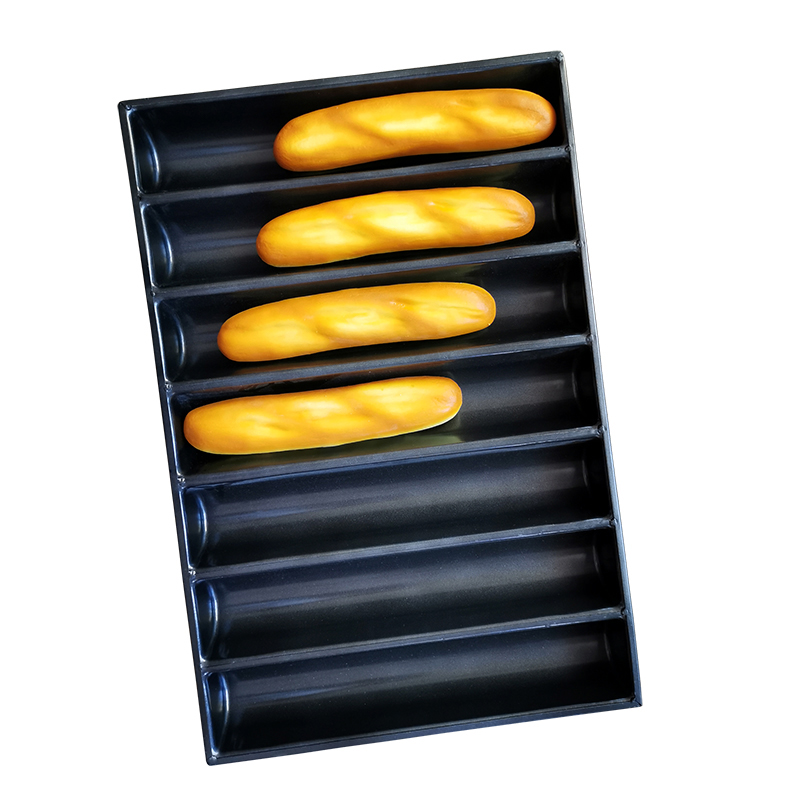
Fluted pans cradle the dough perfectly during rapid expansion. The curved, ventilated flutes maintain cylindrical integrity effortlessly. They do this without suffocating the lower surface area. Flat surfaces often let high-hydration doughs spread outward into flat puddles. Flutes force the loaf to rise upward against gravity. The bread retains its classic, slender profile. Consistent shape retention improves presentation and portion control significantly. You achieve uniform loaves that look identical in the bakery case.
Rapid heat absorption and cooling are essential for bakeries. A perforated aluminum baguette pan offers superior thermal conductivity. Stainless steel heats too slowly and spreads heat unevenly. Carbon steel retains heat too long, risking overbaked bottoms. Aluminum reaches optimal baking temperature incredibly quickly. It also cools down fast when removed from the hot oven. This rapid cooling prevents residual baking on the resting rack. Professional kitchens universally prefer aluminum for its predictable thermal behavior.
Dough extrudes through holes if perforations are too large. Wet doughs sink into wide gaps during the final proofing stage. This sinking causes frustrating sticking and tearing after baking. We must evaluate hole size strictly against hydration levels. Extremely wet doughs require tighter perforation grids to maintain surface tension. A mismatched pan guarantees ruined loaves and wasted labor. Always match the perforation gauge to your specific dough formulation.
Standard micro-perforation diameters range safely between 2mm to 3mm. This precise size maximizes airflow while supporting 70%+ hydration doughs. The density of holes matters just as much as diameter. Too many holes weaken the overall pan structure. The right balance ensures maximum durability and perfect ventilation. Follow these general guidelines when selecting perforation specs:
Keep hole diameters below 3mm for high-hydration artisanal doughs.
Ensure perforations cover at least 40% of the flute surface area.
Verify hole edges are smooth to prevent dough snagging.
Avoid oversized drainage slots unless baking very stiff doughs.
Bare aluminum requires heavy, consistent greasing to prevent sticking. PTFE (Teflon) offers excellent release but degrades under intense commercial use. Commercial silicone glazes provide a highly durable, food-safe alternative. Silicone withstands high-volume baking environments effectively. It significantly reduces your daily reliance on expensive release oils. We prefer silicone for strict chemical compliance and extended longevity. Let us look at how different materials compare in a professional setting.
Table 1: Pan Coating Performance Comparison
Coating Type | Release Reliability | Estimated Lifespan | Maintenance Requirement |
|---|---|---|---|
Bare Aluminum | Low | Indefinite (No coating to peel) | Heavy greasing and scraping needed |
PTFE (Teflon) | Excellent | 1,000 - 1,500 bakes | Avoid all abrasive cleaning tools |
Silicone Glaze | Very Good | 2,000 - 3,000 bakes | Gentle washing, no hard scraping |
You must size pans precisely to match your specific ovens. Considerations include rotary, deck, or convection oven dimensions. Standard US full-size sheets measure exactly 18x26 inches. European ovens often require customized metric sizing. Mismatched commercial baguette pans disrupt critical airflow in convection systems. Blocked air currents cause uneven baking across the rack. Always verify your internal oven clearance before ordering in bulk. Proper fitment ensures maximum rack utilization and consistent heat distribution.
Flute count directly impacts your final loaf dimensions. You must evaluate 4-row, 5-row, and 6-row designs carefully. Your choice depends entirely on targeted loaf weight and diameter. A 4-row pan fits thicker, traditional artisan loaves perfectly. A 6-row design suits thinner, highly uniform sandwich production. Daily production volume dictates how many flutes you need per pan. Narrow flutes yield crispy breadsticks, while wider flutes accommodate hearty deli loaves. Match the flute width to your scaling weight.
High-volume commercial bakeries constantly face unique logistical challenges. Sometimes standard off-the-shelf pans fall completely short. You should invest in a custom perforated baguette tray for automated production lines. Customization includes heavy reinforced frames to prevent heat warping. You can also specify exact flute depths for proprietary recipes. Advanced non-stick coatings optimize your automated loading and unloading machines. Custom tooling maximizes long-term operational efficiency and reduces product waste.
Perforated pans transfer heat much faster than solid steel pans. You must adjust your standard oven settings immediately. Drop your bottom-heat temperatures slightly when making the switch. We recommend lowering it by 10 to 15 degrees Fahrenheit. This simple adjustment completely prevents base scorching. It allows the crumb core to bake fully before the crust burns. Watch the first few batches closely to fine-tune your deck temperatures. Consistent calibration yields predictable crust development.
Steam penetrates perforated pans immediately upon injection. Solid pans typically buffer steam contact with the dough base. Because of this direct exposure, initial steam times may need shortening. Over-saturating the lower crust creates a terribly gummy texture. Monitor your steam injection closely during the first five minutes. Reduce the duration to avoid drowning the bottom surface. Implement these key steps to master steam control:
Delay steam injection by 10 seconds after loading the pans.
Reduce total steam time by 15% compared to solid pan recipes.
Open oven dampers slightly earlier to vent residual moisture fast.
Check the pan underside; if wet, decrease your steam volume further.
Bakers frequently debate proofing directly in the pan versus using a traditional baker's couche. A linen couche wicks away moisture for a thicker, chewier crust. Proofing in the pan saves valuable transfer time and labor. If proofing in the pan, mitigate sticking risks very carefully. Use appropriate dusting requirements before loading the dough. Rice flour and semolina work best for this application. They create a dry, heat-resistant barrier against the bare metal. Proper dusting ensures a flawless release after baking.
Transitioning to perforated pans represents a deliberate upgrade to oven thermodynamics. It is not just a simple hardware change. Upgrading alters how heat and moisture interact with your dough. We advise buyers to prioritize heavy-gauge aluminum for ultimate durability. Choose appropriate perforation sizing over cheaper budget options. This approach ensures consistent crust quality and long-term operational longevity. Audit your current crust failures to identify specific airflow issues. Measure your oven clearances carefully before making any purchases. Request spec sheets for commercial-grade coated pans to secure the best fit for your bakery.
A: High-hydration dough is typically safe up to 75% hydration without sticking issues. If you push hydration higher, the wet dough might seep into the micro-perforations. We recommend proper flour dusting with rice flour or semolina. Alternatively, invest in specialized silicone coatings designed for extremely wet doughs to prevent sticking.
A: No, you do not need to preheat them. Unlike baking stones or baking steels, aluminum pans boast high thermal conductivity and a thin gauge. They absorb oven heat instantly. Cold loading the dough directly onto room-temperature pans is standard bakery practice.
A: Avoid abrasive scrubbing pads that ruin non-stick glazes. We advise relying on dry brushing to remove excess flour or seeds. Perform occasional gentle washing with mild soapy water. Never soak these pans for long periods. Soaking degrades commercial silicone coatings and promotes premature wear.
A: Yes, they are highly versatile. You can bake long rolls, hoagies, and ciabatta strips in them. The dough structure must simply be firm enough to be supported by the fluted shape and perforation size. They excel anywhere rapid crust development is desired.


