
English


Views: 0 Author: Site Editor Publish Time: 2026-08-05 Origin: Site


Industrial bakeries operate at massive scales where minor inefficiencies compound into major financial losses. Facilities frequently hit severe operational bottlenecks when using standard off-the-shelf pans on automated lines. High-speed conveying systems routinely suffer from mechanical jamming, uneven heat distribution, and rapid coating degradation. Upgrading to tailored equipment requires balancing upfront tooling costs against long-term throughput gains. Production managers must carefully weigh product consistency and machinery lifespan before making this critical infrastructure shift.
We provide a comprehensive, evidence-based framework for specifying, evaluating, and sourcing highly durable custom baking trays. You will explore essential criteria like automation compatibility, advanced material dynamics, and application-specific engineering features. Finally, we show you how to navigate complex vendor capabilities and stringent food safety regulatory requirements confidently.
Transitioning from standard (full/half-size) pans to custom dimensions is primarily driven by automation compatibility and yield optimization.
Material selection and coating types (PTFE vs. silicone) directly impact thermal conductivity, release rates, and replacement cycles.
Application-specific engineering—such as custom mold spacing and airflow perforations—mitigates edge-burn and standardizes bake times.
Vendor evaluation should prioritize prototyping capabilities, transparent MOQs, and compliance with food safety standards (FDA/EU).
Standard commercial sheet pans often fail in demanding, high-volume environments. They rapidly warp under continuous thermal shock. They also feature footprints unsuited for specific automated conveyor belts. This basic mismatch causes frequent mechanical jamming. Equipment damage follows shortly after. Production managers must re-evaluate their tooling to maintain efficiency. Attempting to force standard sizes into highly specialized cooling towers is a common mistake. You risk damaging expensive robotic handling arms.
Several success criteria dictate the need for bespoke solutions. Yield optimization sits at the top. You want to maximize the number of baked units per tray. However, you cannot sacrifice crucial airflow between products. Optimal spacing ensures consistent crumb structure across every batch. Poor spacing leads to pale edges and underbaked centers. Tailored engineering solves this.
Automation alignment is another primary driver. Industrial baking trays require precise dimensional tolerances. Robotic depanning, automated stacking, and industrial washing systems demand strict uniformity. A tolerance drift of just a few millimeters disrupts robotic arms entirely. Tailored designs eliminate these costly alignment failures.
Finally, consider your return on investment. Purpose-built designs reduce crippling rates significantly. Your pans enjoy a longer useful life. Fewer production stoppages occur on the line. You save money daily by avoiding unplanned maintenance pauses. The upfront engineering expense quickly pays for itself.
Most bakeries understand standard baseline footprints. A typical full-size sheet pan measures 18 by 26 inches. Smaller operations rely heavily on these standard dimensions. However, industrial facilities only use these as a loose reference point. Automated lines usually require completely different outer dimensions.
Oven types and conveyor widths dictate exact sizing. Tunnel ovens handle massive, continuous throughput. Rack ovens use strict vertical spacing constraints. Spiral cooling conveyors require specific edge profiles. You must engineer your trays to match these exact physical parameters. A perfectly sized tray maximizes tunnel oven real estate. This boosts your hourly yield dramatically.
Dimensional tolerance ensures structural integrity. Mechanical handling equipment moves at incredible speeds. Precision tolerances, often within single millimeters, prevent catastrophic jamming. If a pan expands too much under heat, it gets stuck. Engineers calculate thermal expansion rates during the design phase. They adjust the cold dimensions to ensure perfect hot dimensions. This careful math prevents conveyor belt pile-ups.
Stacking and storage mechanics also demand attention. You need custom nesting features. Deep nesting saves valuable floor space. Banding protects delicate coatings during storage. It prevents abrasive metal-on-metal contact. Operators can move large stacks safely. Proper nesting designs extend the usable life of custom baking trays significantly. You minimize accidental drops and edge denting.
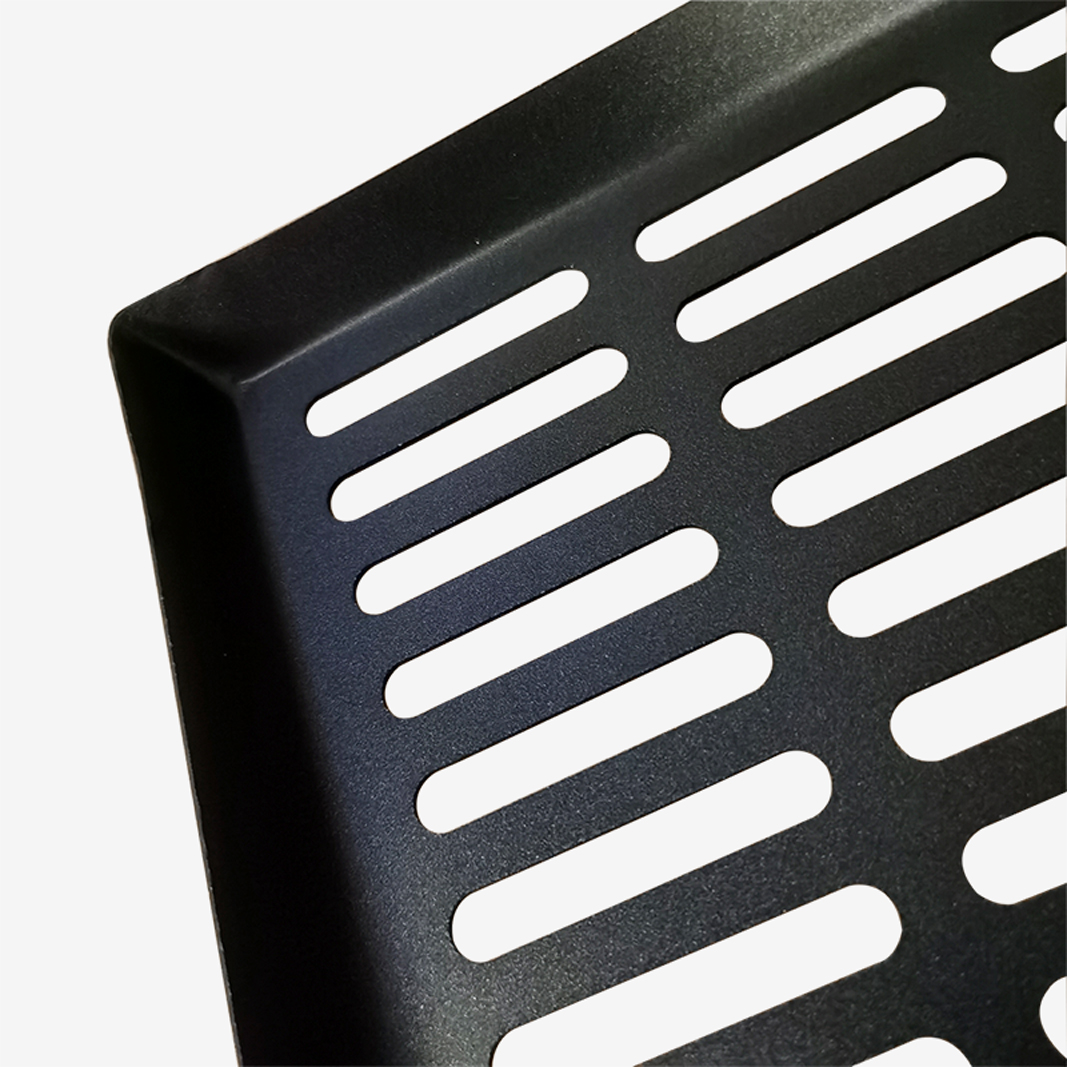
Material choice dictates thermal performance and pan longevity. Aluminized steel dominates high-volume bread and cake lines. It offers exceptional durability. It retains heat beautifully for deep, even baking. The steel core resists denting. The aluminum layer prevents corrosive rust. Heavy-gauge options resist thermal warping perfectly.
Anodized aluminum serves a different purpose entirely. It excels at rapid heating and cooling cycles. Cookie and pastry lines rely on this quick thermal response. Anodized surfaces harden the metal. They resist abrasion during scraping and cleaning processes. It remains lightweight, reducing strain on conveyor motors.
Non-stick coatings determine release rates and maintenance schedules. Silicone glazes provide a cost-effective solution for standard baking. However, they degrade relatively quickly. You must re-glaze them frequently to maintain release properties. This adds considerable logistical overhead.
PTFE and fluoropolymer coatings require higher upfront capital. Yet, they handle extremely sticky applications effortlessly. High-sugar goods need these robust coatings. Automated depanning relies on instant, flawless release. PTFE delivers this consistency over thousands of baking cycles. It prevents product tearing completely.
You must balance coating lifespan against upfront costs. Recoating logistics matter. Calculate how often pans leave the facility for stripping and recoating. A durable PTFE coating minimizes these disruptive service intervals.
The following data illustrates common coating performance metrics:
Coating Type | Primary Application | Estimated Durability (Cycles) | Cost Profile |
|---|---|---|---|
Silicone Glaze | Standard breads, buns, low-sugar doughs | 300 - 800 | Low Upfront, High Maintenance |
PTFE (Fluoropolymer) | High-sugar cakes, sticky pastries, automated lines | 1,000 - 3,000 | High Upfront, Low Maintenance |
Silicone Elastomer | Hamburger buns, heavy dense doughs | 1,500 - 2,500 | Moderate Upfront, Moderate Maintenance |
Perforations play a critical role in crust development. Engineers calculate precise hole sizes. They optimize hole density for targeted airflow. Better airflow accelerates cooling times significantly. Crisp artisan crusts require carefully mapped perforation patterns. Moisture escapes evenly through these vents.
Edge reinforcement styles prevent thermal warping. Continuous industrial use stresses the metal constantly. Wire-in-rim designs offer excellent rigidity. Banding provides an even stronger perimeter defense. Thick metal bands resist impact damage from robotic handlers. Choosing the right edge ensures pans stay flat forever.
Different bakery products demand highly specialized engineering. Off-the-shelf pans cannot accommodate nuanced recipe requirements. Tailored designs address specific dough behaviors and extraction methods.
Batter-based products require precise cavity engineering. Key design elements include:
Mold Volume: Exact volumetric calculations prevent overflow and ensure uniform portion control.
Draft Angles: Angled cavity walls facilitate instant automated extraction. Vacuum depanners require specific angles to lift delicate cakes without tearing.
Cavity Spacing: Generous spacing prevents thermal bridging. Heat circulates freely between molds, eliminating raw centers and burnt edges.
Baguettes need structured support and aggressive venting. Custom channel widths dictate the final loaf shape. Perforation patterns guarantee crust consistency across the entire batch. Shallow channels suit ciabatta, while deep U-flutes support traditional French loaves. Screen rigidity prevents sagging under heavy dough weights. A sagging screen creates deformed, unsellable loaves.
Cookies spread during baking. Surface warping ruins uniform spread completely. Flat sheets must remain absolutely level under intense heat. Engineers use heavy-gauge materials to mitigate thermal distortion. Perfect flatness also enables automated scraping. Cleaning blades glide smoothly without snagging on high spots. High spots strip expensive coatings instantly.
Rolling out a new tray system carries operational risks. Proper vendor vetting and testing protocols mitigate these dangers. Rushing into mass production is a common, costly mistake.
Never bypass the prototyping phase. A trial run of 10 to 50 prototype units is mandatory. You must test thermal dynamics in your actual ovens. You also need to verify robotic handling compatibility. Even minor tolerance issues will appear during these physical line tests. Adjusting a prototype die costs much less than scrapping a full production run.
Select partners who control their entire manufacturing process. Look for the following capabilities:
In-house Tooling: Manufacturers with internal die-making capabilities pivot faster. They implement prototype revisions quickly and cost-effectively.
Transparent MOQs: Understand Minimum Order Quantities upfront. Custom tooling requires investment, so expect MOQs to reflect production realities.
Post-Sale Support: Pans require ongoing maintenance. Choose vendors offering comprehensive recoating, deep cleaning, and metal straightening services.
Food contact safety is non-negotiable. Materials and release coatings must meet strict standards. Ensure your vendor complies with FDA regulations. European facilities require regional EU food contact certifications. NSF certifications provide an additional layer of trust. Demand compliance documentation before finalizing any purchase orders. Ignoring compliance invites severe legal liabilities.
Customized baking equipment represents a strategic infrastructure investment. This tooling directly dictates production efficiency. It protects product quality and standardizes output. Eliminating jams and uneven baking transforms your bottom line. Automation requires precision, and tailored pans deliver exactly that.
We recommend buyers conduct a baseline audit immediately. Document your current pan failure rates. Identify exactly where standard pans bottleneck your automated lines. Draft a preliminary dimensional and material specification sheet. Gather this data before contacting manufacturers. Clear specifications ensure faster prototyping and better final results.
A: Custom tooling costs heavily influence MOQs. Manufacturers usually set minimums between 100 and 500 units. Complex designs requiring bespoke stamping dies drive this number higher. Simpler dimensional modifications to standard frames might allow smaller batches. Always discuss tooling amortization with your chosen vendor.
A: A high-quality PTFE coating typically lasts between 1,000 and 3,000 baking cycles. Lifespans vary wildly based on product ingredients. High-sugar recipes degrade coatings faster. Harsh chemical cleaning or aggressive mechanical scraping also reduces longevity. Proper automated washing extends the usable life significantly.
A: Yes, manufacturers can modify standard 18"x26" frames. They can weld or rivet custom stamped cavities into existing standard dimensions. This hybrid approach saves money on outer-frame tooling. However, fully custom dimensions remain necessary if the standard frame causes conveyor jamming.
A: Expect a 4 to 8-week lead time for initial physical samples. This window covers CAD design, engineering approvals, and custom die manufacturing. Material procurement and initial test stamping also consume time. Rushing this phase often results in costly automation failures later.


